

Banned Palestine Action Documentary Circulates via Spanish Screening Linked to Radical Networks
Executive Summary
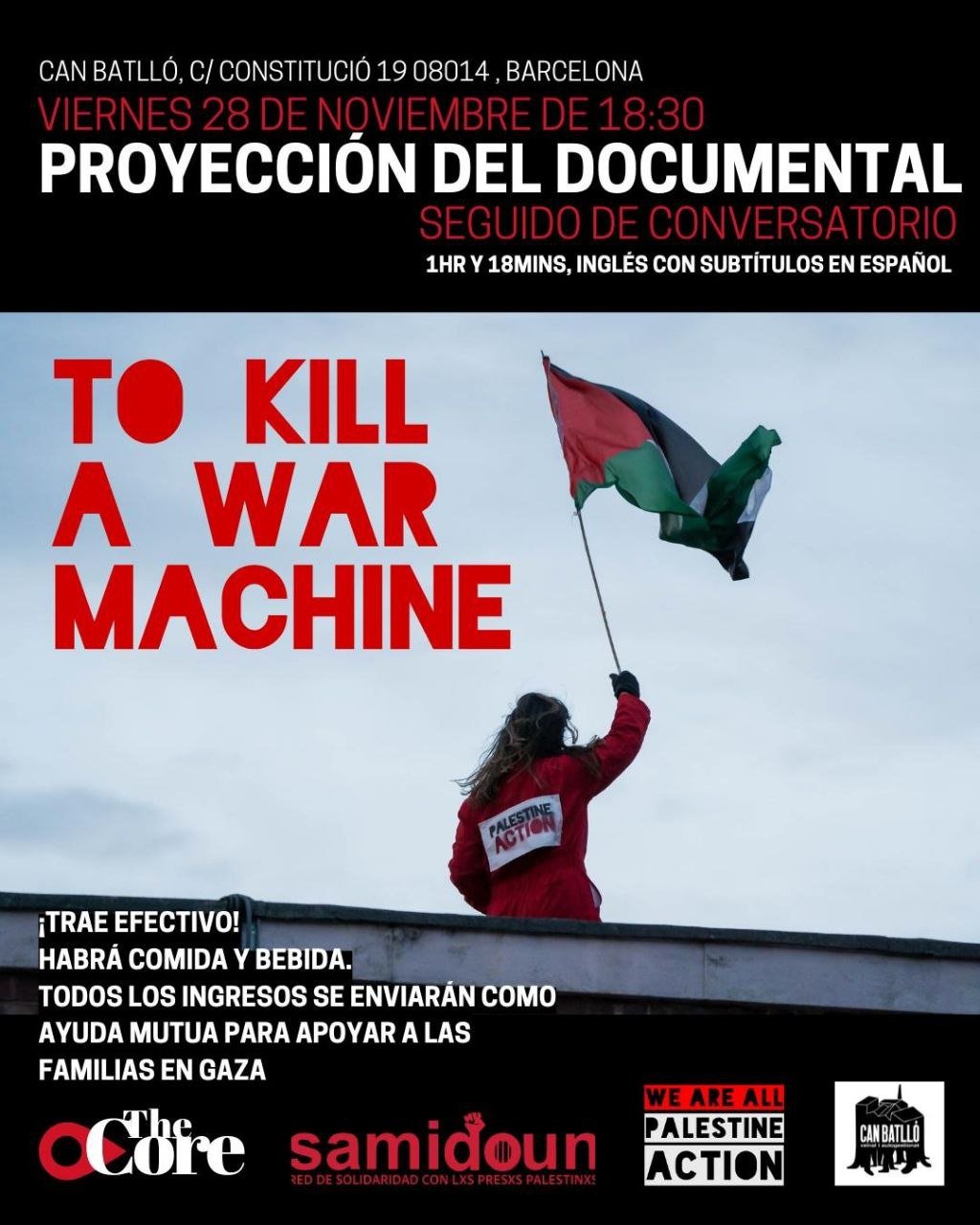
Despite the UK government’s proscription of Palestine Action as a terrorist organization and the film’s withdrawal by its producers, activists in Barcelona are promoting a public screening of “To Kill a War Machine” at the Can Batlló social center on November 28. The event flyer describes the group as one that “attacked Elbit Systems factories” and notes that the organization “was designated terrorist,” while inviting attendees to watch the film, join a discussion, and bring cash for food. This screening illustrates how supporters are shifting to cross border venues and movement spaces to keep the film in circulation and to contest the UK ban, turning the documentary into a symbolic rallying point for transnational pro Palestine and anti arms trade activism.
Analysis
The Barcelona event shows that the UK proscription of Palestine Action and the resulting legal risk around “To Kill a War Machine” have not stopped the film’s use as a mobilization tool. Instead, supporters are relocating screenings to foreign jurisdictions and embedding them within radical social centers where broader pro Palestine, anarchist, and anti militarist networks intersect.
A Spanish language announcement shared via the Samidoun network advertises a joint event with “The Core” at Can Batlló in Barcelona on Friday November 28, promoting a screening of “To Kill a War Machine,” describing it as a documentary “about Palestine Action, a group that attacked Elbit Systems factories,” and explicitly noting that the organization “was designated terrorist.” It also promises a discussion and food and instructs attendees to bring cash.
In their public statement after proscription, the film’s directors at Rainbow Collective said they had taken down the online version and stopped authorizing screenings until they could get clear legal guidance, warning that future distribution that could be interpreted as showing sympathy for or inviting support for a proscribed organization might be illegal under UK law. They stressed that this was to protect communities who wanted to host events.
A detailed ArtReview analysis describes how the proscription transformed “To Kill a War Machine” into a “living fault line” in the debate over documentary and activism, noting that the film’s early release triggered a spike in downloads and that it now functions as a symbol of state overreach and an effort to erase images of direct action against Israeli arms manufacturers.
Previous reporting on the UK ban of Palestine Action and record mass arrests in London shows that supporters have already engaged in deliberate civil disobedience by displaying placards and publicly backing the group after proscription, and that critics see the ban as an excessive use of terrorism powers against a direct action movement targeting military contractors.
Together these elements indicate that “To Kill a War Machine” is moving from a documentary about a militant protest campaign into a political object in its own right, used to challenge the legitimacy of the UK proscription and to sustain Palestine Action’s narrative abroad even while the group is legally suppressed at home. The Barcelona screening represents a method for sympathetic actors in continental Europe to keep the story alive, recruit new supporters, and normalize the idea of attacking arms industry infrastructure, while also testing how far authorities outside the UK are willing to tolerate events centered on a proscribed group.
