

ISIS Media Outlet Issues Kurdish-Language Statement Claiming Symbolic Flag Display in Kurdistan
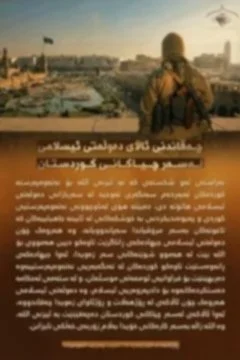
Source: Fursan al-Tarjuma
Executive Summary
An ISIS-affiliated media network released a Kurdish-language poster and accompanying written statement in Rajab 1447 AH claiming the symbolic raising of the Islamic State flag in the mountains of Kurdistan. The statement frames the act as a message of persistence, ideological legitimacy, and divine mandate rather than announcing a concrete military operation.
Analysis
The released material consists of both visual propaganda and a written ideological statement, which together serve a morale and signaling function rather than providing verifiable operational detail.
The Kurdish-language text emphasizes that the act of raising the flag is meant as a symbolic reminder, asserting that the Islamic State and its ideology remain present in Kurdistan regardless of military setbacks. The statement frames the mountains as a historic refuge and arena of jihad, invoking endurance, patience, and religious obligation rather than imminent action.
Key themes translated and summarized from the statement include:
A claim that the Islamic State’s banner has been raised in the mountains of Kurdistan as a sign of continuity and defiance.
An assertion that geography, borders, and modern political entities do not negate what the group describes as its religious legitimacy.
Language portraying the act as a warning to perceived enemies and a reassurance to supporters that the group has not disappeared.
Religious framing that emphasizes perseverance, sacrifice, and eventual victory by divine will, without specifying attacks, targets, or timelines.
A narrative positioning Kurdish mountainous terrain as historically suitable for guerrilla persistence and concealment, echoing earlier ISIS and jihadist rhetoric about operating from remote terrain.
The statement does not include operational claims such as casualties, clashes, or specific locations that could be independently verified. Instead, it relies on symbolism and religious messaging, consistent with ISIS media outputs intended to sustain ideological cohesion rather than announce tactical developments.
Attribution to Ansar production elements and dissemination via Fursan al-Tarjuma, a translation-focused outlet, aligns with ISIS’s decentralized media ecosystem, where regional language channels are used to tailor messaging to specific audiences, in this case Kurdish-speaking populations.
Sources
TechHaven – Fursan al-Tarjuma
