

Anarchist Poster Calls for Infrastructure Sabotage Against Surveillance and Control Systems
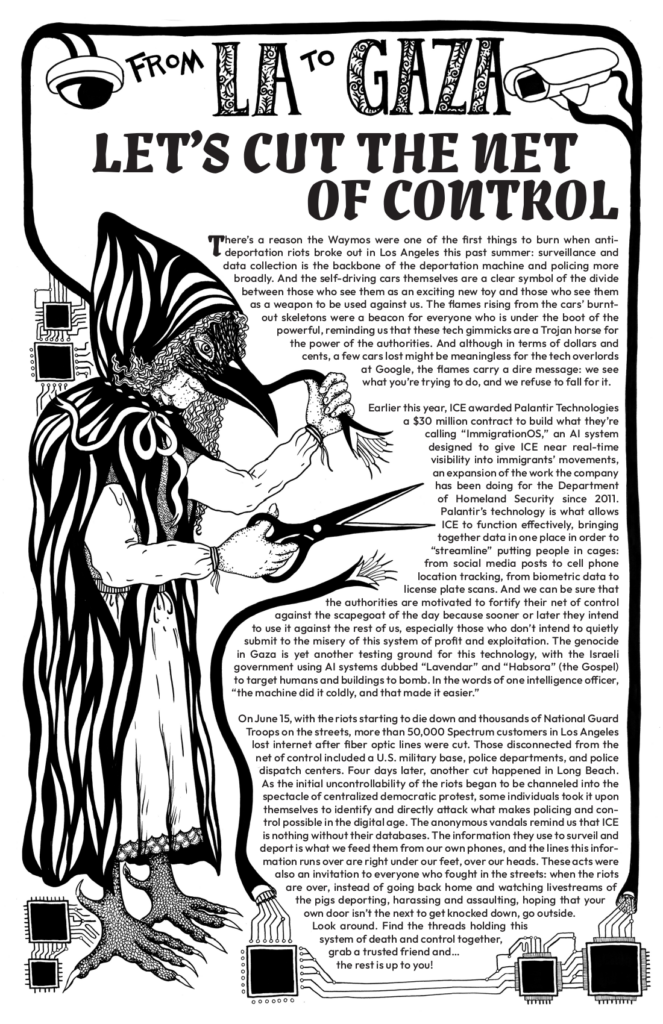
Source: Unravel NoBlogs
Executive Summary
A newly circulated anarchist poster titled “From LA to Gaza: Let’s Cut the Net of Control” frames surveillance technology, data infrastructure, and corporate state partnerships as central tools of repression and genocide. The poster explicitly references recent unrest in Los Angeles, attacks on telecommunications infrastructure, and Israeli military use of artificial intelligence systems in Gaza, presenting them as interconnected examples of a global control architecture. It encourages decentralized action against digital and physical infrastructure that enables policing, deportation, and military targeting, positioning sabotage as a legitimate and necessary response.
Analysis
The poster articulates a coherent anti surveillance and anti militarization narrative that links domestic policing in the United States with Israeli military operations, emphasizing technology as the unifying mechanism of control.
The text references the burning of Waymo autonomous vehicles during anti deportation riots in Los Angeles, portraying surveillance and data collection as the backbone of deportation systems and broader state repression.
It highlights Palantir Technologies’ reported contracts with US Immigration and Customs Enforcement and the Department of Homeland Security, describing data fusion, biometric tracking, and social media monitoring as essential to modern policing and border enforcement.
The poster draws a direct parallel to Gaza, citing Israeli use of AI systems referred to as “Lavender” and “Habsora” to automate targeting of people and buildings, framing these tools as extensions of the same technological logic used against marginalized populations elsewhere.
It recounts June incidents in Los Angeles in which fiber optic cables were cut, disrupting internet access for civilians, police departments, and a US military base, presenting these acts as effective resistance that briefly disrupted what the poster calls the “net of control.”
The visual imagery reinforces the message through symbolism. A hooded figure cutting cables with scissors dominates the composition, while surveillance cameras, circuit boards, drones, and network diagrams surround the scene. This imagery frames infrastructure sabotage as precise, targeted, and empowering rather than indiscriminate. The closing call encourages readers to identify and attack the physical foundations of digital control systems collectively and locally, stressing trust, decentralization, and continuation beyond protest cycles.
Overall, the poster reflects a convergence of anarchist, anti surveillance, and pro Palestinian militant rhetoric. While it does not provide technical instructions, it explicitly legitimizes and encourages attacks on communications and data infrastructure, aligning with recent real world acts of arson, vandalism, and sabotage claimed by similar milieus in Europe and North America.
