

Explosion Lightly Damages Jewish School in Amsterdam; IMCR Claims Attack as Part of Belgium–Greece “Campaign” Narrative
Source: X
Executive Summary
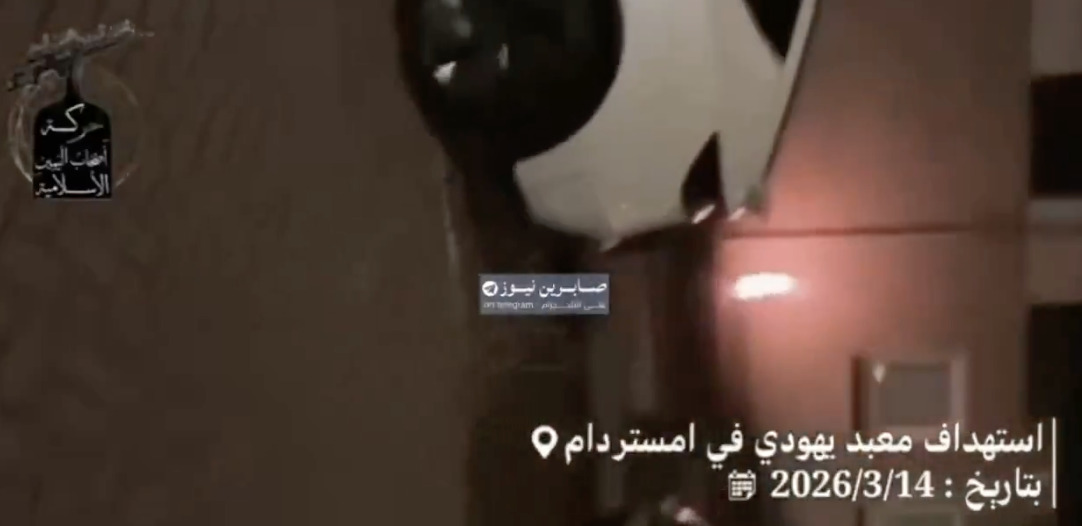
A small explosive device damaged the exterior of the Cheider Orthodox Jewish school in Amsterdam with no injuries reported. Police have surveillance footage of a suspect placing and igniting the device, and Dutch authorities treated the incident as a targeted attack on the Jewish community while increasing security at Jewish sites. A newly surfaced brand calling itself the Islamic Movement of the Companions of the Right (IMCR) has claimed responsibility for the Amsterdam blast and has also claimed attacks in Belgium and Greece, but the group’s real-world existence, structure, and direct involvement remain unverified by authorities in publicly available reporting.
Analysis
The Amsterdam incident is a low-complexity attack designed to intimidate. The device caused limited damage (exterior scorching and minor structural impacts such as a rainpipe/outer wall) and no injuries, but the target choice is high-signal: an Orthodox Jewish school in Buitenveldert, an area associated with Amsterdam’s Jewish community.
Investigators appear to have strong starting material. Reporting indicates police have CCTV showing a suspect placing and igniting the device. Additional descriptions in open reporting reference video that appears to show the suspect leaving on a scooter. If accurate, that suggests a quick placement and rapid departure rather than a prolonged on-site operation.
Dutch authorities moved quickly to treat this as a community-targeted incident, not random vandalism. Public messaging from city leadership framed the blast as a deliberate attack against the Jewish community and coincided with increased protective measures at Jewish institutions. Separate reporting describes arrests of three males (reported ages 17–19) near another synagogue after suspicious behavior and a description match, but open reporting has not confirmed those arrests are tied to the school device or that they identify the bomber.
The key development is the claim environment around IMCR. Multiple outlets and analysts report that IMCR is a previously unknown label that surfaced recently and is attempting to frame a series of incidents as a connected campaign. The group has claimed:
The Amsterdam school explosion.
The March 9 blast at a synagogue in Liège, Belgium.
An additional attack claim in Greece (details appear thin in open reporting).
This is where the line has to stay clean. The fact that IMCR claimed the attack is straightforward. The harder question is whether IMCR is a real, coherent organization or a name being used to stitch unrelated incidents together for credibility and momentum.
IMCR’s credibility in open sources is still limited by a basic test: public-facing claims appear to rely heavily on footage and details that are already circulating, rather than providing specific non-public information that would strongly authenticate the claimant. That does not make the claim false, but it keeps confidence low until police/prosecutors provide corroboration or until the claimant demonstrates unique knowledge.
Operationally, the threat does not depend on whether IMCR is “real.” The tactic is repeatable and the target set is clear. Small devices placed at entrances of Jewish institutions reliably force security escalation, generate fear, and pull police resources, even when damage is minor. The short-horizon regional pattern matters more than the branding: Liège, Rotterdam-area synagogue reporting, and Amsterdam occurring in a tight window increases the risk of follow-on attempts and copycats.
