

University of Delaware Student Arrested With Machinegun and Martyrdom Manifesto After Surveillance-Oriented Attack Planning
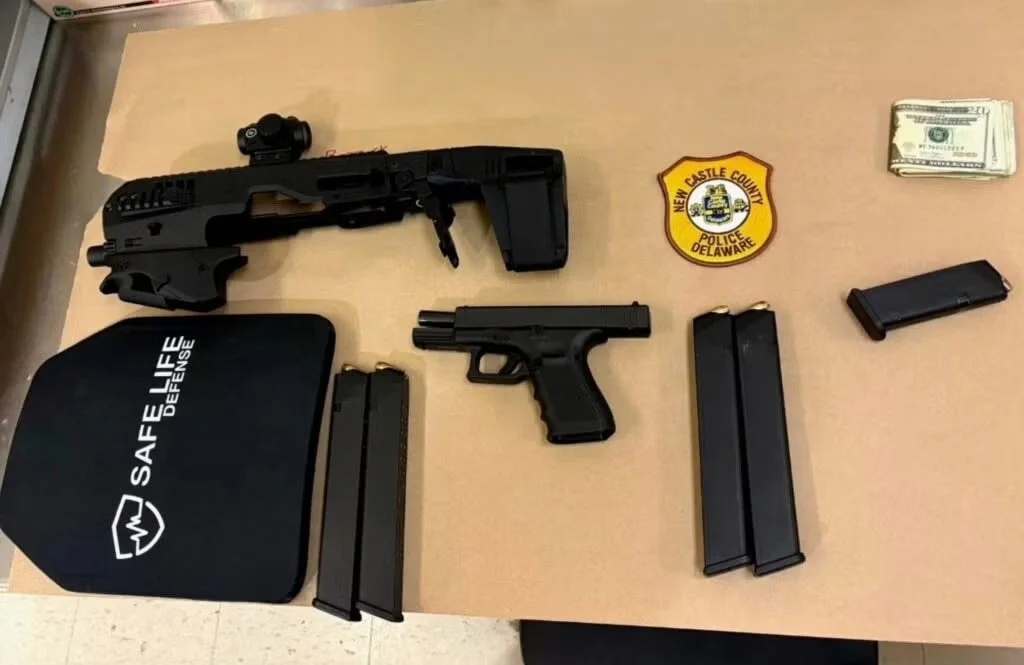
Source: New Castle County
Executive Summary
A 25-year-old University of Delaware student, Luqmaan Khan, was arrested after New Castle County Police discovered a converted machinegun, extended magazines, body armor, and a handwritten notebook outlining attack concepts, target surveillance, and martyrdom rhetoric. The notebook included the phrase “kill all – martyrdom,” building entry and exit sketches labeled “UD Police Station,” and a named University of Delaware Police Department officer. A subsequent FBI search of Khan’s home recovered a second illegal machinegun conversion device, a rifle with optics, hollow-point ammunition, and tactical gear. While investigators have not publicly linked Khan to any extremist organization, the content of his writings reflects a strong fixation on martyrdom concepts and operational security, aligning with violent extremist ideation. The rapid intervention by patrol officers likely prevented an imminent threat to law enforcement or the university campus.
Analysis
Khan’s conduct and recovered materials suggest a pre-operational individual actor who had begun developing capability, conducting basic surveillance, and documenting a target of interest. His writings centered on martyrdom as an aspirational outcome and described methods for avoiding police detection once an attack was underway, indicating intent beyond fantasy and moving toward planning.
During a late-night stop in Canby Park West, police found a .357 Glock fitted with a plastic conversion brace, three additional loaded 27-round magazines, an armored plate, and a notebook discussing weapons use, attack methodology, and evasion of law enforcement.
The notebook contained a hand-drawn building layout marked “UD Police Station,” with entrance and exit notes and a named university police officer, signaling at least preliminary target selection and reconnaissance.
The phrase “battle efficiency: kill all – martyrdom” recurred in the notes, and investigators report that martyrdom themes appeared repeatedly throughout his writing.
In a recorded interview, Khan reportedly stated that becoming a martyr was “one of the greatest things you can do,” and one of his personal goals.
A search of his home uncovered a Glock 19 equipped with a machinegun switch, a .556 rifle with scope and red dot, eleven additional extended magazines, hollow-point rounds, and a two-plate tactical vest with one plate installed, demonstrating capability building consistent with lethal intent.
The presence of a named law enforcement officer, a detailed building sketch, and notes on evasion techniques match typical indicators of late-stage lone-actor mobilization seen in prior cases. Though officials have not alleged a specific ideological group, the heavy emphasis on martyrdom echoes jihadist framing, while the possession of tactical gear and an illegal automatic-conversion device fits broader patterns across extremist subcultures. The notebook’s focus on police and campus locations elevates the likelihood that a law-enforcement-focused attack was being considered.
Law enforcement charged Khan federally for machinegun possession, and a second federal charge was added for possession of an unregistered firearm. State charges are also pending.
University administrators noted that Khan has been banned from all campus properties, and no further threats are known at this time.
Authorities publicly emphasized that the response began with routine patrol activity, highlighting that early, unplanned encounters continue to be the primary method for disrupting lone-actor plots before execution.
Khan’s background—U.S. citizenship, university enrollment, and lack of publicly known extremist group affiliation—aligns with broader trends of self-directed actors who radicalize toward violence through internal fantasy, private writings, and independent capability acquisition. His combination of machinegun conversion devices, extended magazines, tactical gear, and detailed target notes indicates the potential for high lethality had the plot matured further. He represents the category of threat that remains difficult to detect through intelligence channels and is most often disrupted through frontline policing, community observation, or chance encounters.
