

Belfast Anti-Immigration Riots Spread to Glasgow, Edinburgh, and Southampton as UK-Wide Unrest Accelerates
Source: @WarMonitor3
EXECUTIVE SUMMARY
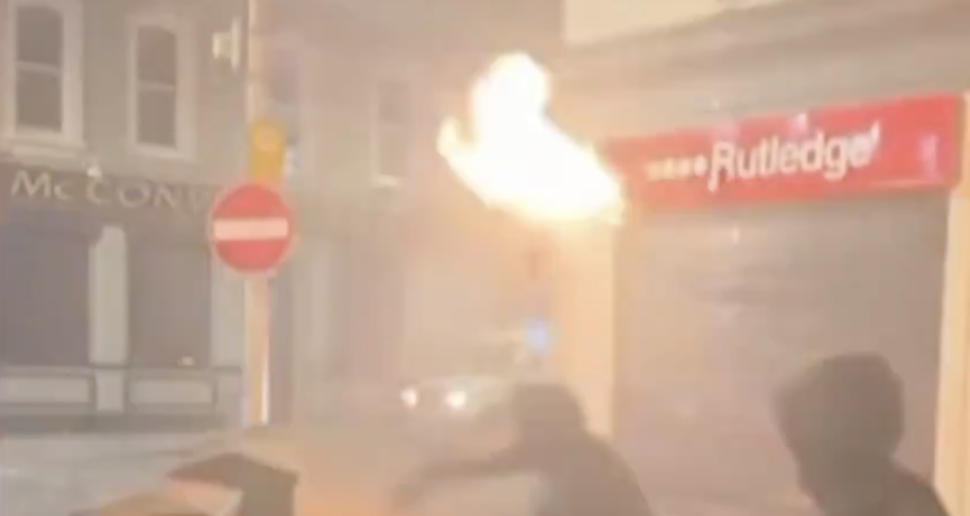
Anti-immigration riots that began in Belfast on June 9 following a knife attack attributed to a Sudanese asylum seeker have spread to Glasgow, Edinburgh, and Southampton, marking the first time this cycle of UK civil unrest has crossed from Northern Ireland to the British mainland. Properties, vehicles, and a bus were burned in multiple cities, and dozens of arrests were made.
ANALYSIS
The confirmed spread to Glasgow, Edinburgh, and Southampton constitutes the trigger condition identified in that report. What began as a localized riot in Belfast has within 24 hours produced concurrent disorder in three additional cities across two nations of the United Kingdom, a pattern that substantially changes the intelligence picture.
The original incident occurred on June 8 when a Sudanese national attacked Stephen Ogilvie, a local man in his 40s, on Kinnaird Avenue in Belfast with a kitchen knife, inflicting serious injuries to his eyes, face, and back. Video footage of the attack circulated rapidly on social media, and by the evening of June 9 riots had broken out across multiple Belfast neighborhoods. At least three houses, a Middle Eastern supermarket, a Glider bus, and numerous private vehicles were set ablaze. Disorder was concentrated along the Crumlin and Lower Newtownards Roads. The Sudanese man involved in the original attack was charged with attempted murder.
On June 10, online coordination across far-right Telegram networks and social media accelerated the spread of the unrest. Channels monitored throughout this briefing cycle, including Nationalist Squads and WhiteVanguard, amplified footage of the Belfast riots alongside calls to replicate demonstrations in mainland UK cities. Political figures including a Reform UK Member of Parliament publicly called for Northern Ireland First Minister Michelle O'Neill to resign, framing the riots as a consequence of immigration policy failures. Nigel Farage was reported in Merseyside during the same period.
The pattern matches the 2024 UK riots that followed the Southport stabbings, in which a single high-profile violent incident attributed to an asylum seeker produced rapid multi-city disorder within 48 to 72 hours. In 2024, that unrest reached more than a dozen UK cities before law enforcement response and online counter-mobilization slowed momentum. The June 2026 cycle is tracking a similar trajectory, with confirmed spread across the Irish Sea to Scotland and England within 24 hours of the initial Belfast outbreak. The 2024 precedent demonstrated that disorder in this pattern tends to peak within five to seven days of the triggering incident.
UK government officials called publicly for calm on June 10. Michelle O'Neill described the riots as "nothing less than disgusting cowardice." The UK Home Office has not yet announced emergency measures or COBRA activation, though both were employed in 2024. Northern Irish police made multiple arrests in Belfast. Whether the mainland UK forces are resourced to simultaneously manage disorder in three cities while supporting Northern Ireland adds a significant logistics dimension to the law enforcement picture.
The intelligence relevance for US law enforcement extends beyond observation of a foreign event. The same online networks amplifying and coordinating the UK riots maintain active US chapters and affiliated channels. US cities with significant asylum seeker and refugee populations, particularly those where a single violent incident involving a foreign national could be rapidly amplified as a cultural or political symbol, should consider reviewing rapid-response protocols for spontaneous crowd events. The UK experience since 2024 demonstrates that the interval between a triggering incident and the onset of riots can be as short as 18 to 24 hours, leaving limited lead time for traditional intelligence-to-action cycles.
The degree of top-down organizational coordination in this cycle, as opposed to spontaneous bottom-up mobilization, remains an open analytical question. The 2024 UK riots produced evidence of both organic response and deliberate agitation by organized far-right networks. Whether the June 2026 spread to three cities simultaneously reflects network coordination or independent replication of the Belfast model will be an important data point for understanding the operational capability of far-right networks currently active across the UK and their US affiliates.
SOURCES
