

Striking Barakah: Iran's Shift To Civilian Nuclear Targets And The US Response Calculus
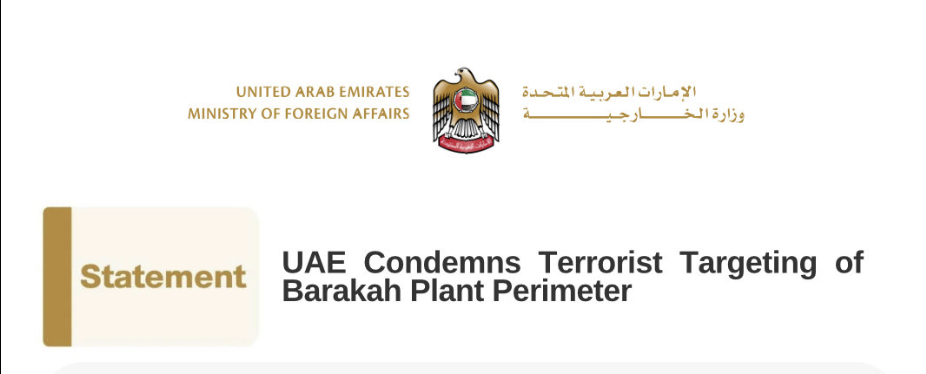
Source: X | @mofauae
EXECUTIVE SUMMARY
Iran's May 17 drone strike on the perimeter of the UAE's Barakah Nuclear Power Plant crosses a threshold the prior fourteen days of escalation had approached without breaching: deliberate kinetic action against operational civilian nuclear infrastructure inside a US partner state. The strike happened despite the IAEA's institutional presence at the facility and despite the UAE's status as the model proliferation customer state in the region. It places Iran outside the protective umbrella that even maximalist nuclear states have historically respected, and it changes the political math for both the immediate US response decision and the broader nonproliferation regime.
ANALYSIS
Barakah is a state nuclear program built explicitly to demonstrate that civilian nuclear technology can be developed responsibly without an enrichment or reprocessing capability. The UAE accepted the IAEA Additional Protocol, signed a 123 Agreement with the United States, and renounced enrichment in its civilian nuclear deal. The plant has operated under continuous IAEA safeguards since first criticality in 2020. Striking that facility specifically, rather than the broader Emirati energy sector that Iran already hit at Fujairah on May 13, signals a deliberate Iranian decision to put the model proliferation customer state in the kinetic crosshairs.
Iranian internal communications since the strike have characterized the attack as a perimeter electrical generator hit rather than an attack on the reactors themselves, presumably to argue that the strike fell short of breaching the nonproliferation norm. The argument is operationally thin. The plant lost off site grid power to one reactor, the emergency diesel generators ran, and the international institutional response has been unambiguous. Tehran's framing will not hold in the Western policy environment.
The US response calculus is now structurally different than it was on May 13. A strike package against Iranian nuclear infrastructure (Natanz, Fordow, Isfahan) can now be justified by reference to Iranian conduct against a partner state's civilian nuclear facility rather than purely as preemption against the Iranian weapons program. The political constituency that would have opposed a unilateral US strike on Iranian nuclear sites is materially smaller after the Barakah event.
Russia and China are now in a politically uncomfortable position. Both states have substantial nonproliferation equities and both have historically argued that civilian nuclear infrastructure should be insulated from military action. Iranian conduct against Barakah forces them to either join the IAEA position or to defend a state that has just attacked a civilian nuclear plant. Either choice imposes a strategic cost. The Chinese Ministry of Foreign Affairs has not yet issued a statement. Moscow has been silent.
For the broader nonproliferation regime the longer-term consequence is the most concerning. If a state with Iran's profile can strike a civilian nuclear plant in a neighboring country without immediate consequences, the norm against such strikes weakens. States considering whether to harden their own civilian nuclear infrastructure or whether to pursue indigenous enrichment for security will weigh the May 17 Barakah strike against the institutional response. The institutional response in the coming 14 days will set the precedent for the next decade.
Indicators worth tracking over the next 72 hours include a UN Security Council session that the UAE will probably request, an Iranian Foreign Ministry statement attempting to characterize the strike as Israeli false flag, an Israeli IAF posture change, a B-2 or B-1B movement to Diego Garcia, and any US carrier group posture shift in CENTCOM. CENTCOM has not yet publicly issued a strike package warning to Tehran. The absence of such a warning at this point in the cycle is operationally informative.
SOURCES
