

US Strikes Five Bridges at Iran's Key Oil Port, Confirming Trump's Infrastructure Threat
Source: X | @Osint613
EXECUTIVE SUMMARY
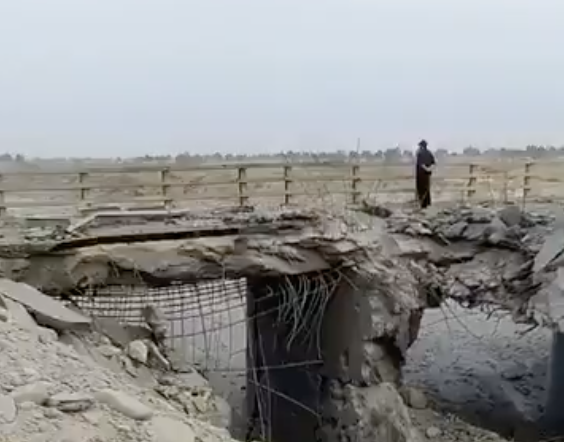
US Central Command (CENTCOM) struck at least five bridges near Bandar-e Imam Khomeyni, Iran's largest petrochemical export port, on July 16 to 17, killing at least three civilians, in the first confirmed US strikes on Iranian civilian transport infrastructure since the conflict began and the specific escalation President Trump threatened three days earlier.
ANALYSIS
The strikes on bridge infrastructure surrounding Bandar-e Imam Khomeyni represent a confirmed execution of the escalation threat President Trump issued on July 14, when he warned he would destroy Iranian bridges, power plants, and energy infrastructure within the week unless Tehran returned to the negotiating table. CENTCOM confirmed operations began at 18:00 GMT July 16 as part of an effort to further degrade Iranian military capabilities. Iranian Foreign Minister Abbas Araghchi stated that three villagers were killed in the bridge shelling; other Iranian sources cited seven killed in the broader July 16 strike package. Trump's timeline of 'within the week' from July 14 was met within 72 hours.
Bandar-e Imam Khomeyni, located in Khuzestan Province near the Iraqi border, is Iran's largest petrochemical export terminal and a critical logistics node for southern Iran. Attacking the road bridges adjacent to this port degrades military logistics, civilian commercial traffic, and humanitarian supply lines simultaneously. Iran has characterized the strikes as deliberate civilian targeting. Al Jazeera published analysis asking why the US is attacking southern Iran's civilian infrastructure as the bridge campaign drew international coverage beyond the Hormuz military reporting. The legal justification CENTCOM is expected to rely on involves classifying bridges as dual-use infrastructure with military logistics value, a framework with precedent in prior US air campaigns that nonetheless attracts significant international legal criticism when applied to civilian population infrastructure.
The bridge strikes are part of the sixth consecutive night of US operations against Iranian targets. Since fighting resumed after the failed Switzerland diplomatic channel, Iran has reported 38 civilian deaths and more than 400 injuries from US strikes, figures CENTCOM has not publicly contested. Bandar Khomeini is also the site of major petrochemical facilities and serves as the export point for a significant portion of Iranian chemical industry output. Disrupting road access to this port affects the Iranian economy in ways that extend well beyond military logistics, which is both the strategic intent and the source of humanitarian law criticism.
Iran's response options are constrained by ongoing CENTCOM strike pressure but have not been exhausted. The Islamic Revolutionary Guard Corps (IRGC) and affiliated proxy networks in Iraq, Syria, and Lebanon retain options to activate against US personnel or facilities. Iran's cyber capabilities, documented repeatedly in CISA and FBI advisories over the past three years, provide a retaliatory avenue against US critical infrastructure that does not require military-on-military escalation and carries significant deniability. The civilian bridge casualty figures specifically are being used in IRGC media to frame the US campaign as a war crimes campaign, a framing designed to justify escalated IRGC retaliation against any category of US target.
The homeland threat dimension is specific and time-bounded. Iranian state media and IRGC-affiliated channels are circulating bridge footage and civilian casualty content through diaspora networks inside the United States. The content is being used to amplify calls for retaliation against American targets and to rally sentiment in Iran-sympathetic communities. Analysts tracking Iran-linked domestic networks should expect increased incitement volume correlated with civilian casualty reporting in the next 48 to 72 hours, consistent with the incitement pattern observed after prior Iranian civilian casualty events during this conflict. Venues associated with significant Iranian diaspora populations and World Cup venue corridors warrant elevated situational awareness during this window.
The broader trajectory of this conflict has moved past the parameters of any surviving diplomatic framework. No ceasefire architecture remains, the Islamabad Agreement has been formally declared void by Iran, and the Swiss channel that briefly produced the Islamabad text is dormant. IRGC strike campaigns now span at least six countries, with Syria reported as a new target category in this cycle. The bridge campaign signals that CENTCOM targeting authority now extends to civilian transport infrastructure supporting strategic port facilities, a significant doctrinal and legal threshold that will shape both international reaction and Iranian escalation calculus for the weeks ahead.
SOURCES
