

Why Greenland Has Become a Strategic Focal Point in Arctic Competition
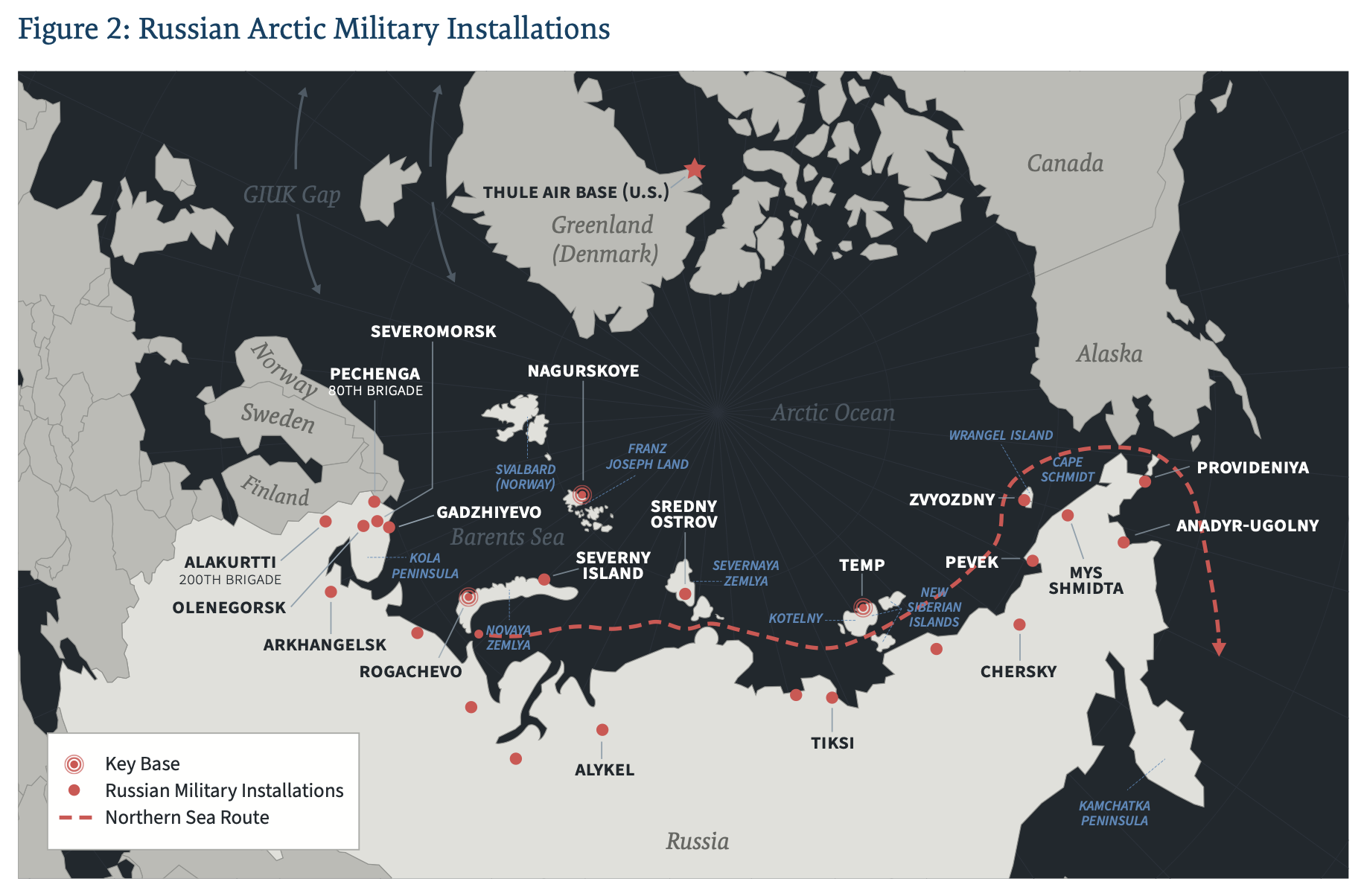
Source: CSIS
Executive Summary
Greenland has emerged as a critical strategic location as global competition expands into the Arctic. Its geography, growing accessibility, and proximity to North America make it central to military warning, missile defense, and undersea security. At the same time, China’s expanding Arctic activities and renewed U.S. political pressure over Greenland highlight how the island has moved from a peripheral territory to a front-line strategic concern.
Intelligence Analysis
Greenland’s importance is rooted first in geography. The island sits astride the shortest routes between North America and Europe and lies directly along key Arctic and North Atlantic approaches. During the Cold War, this position made Greenland central to early warning against Soviet bombers and submarines. That logic never disappeared, but it faded from public attention after the collapse of the Soviet Union. Today, it has returned with urgency as both China and Russia expand their Arctic ambitions and as climate change opens new routes through previously inaccessible waters.
From a military perspective, Greenland functions as a forward sensor and barrier. The island anchors the northern side of the Greenland-Iceland-United Kingdom gap, a historic choke point used to detect submarines moving between the Arctic and the Atlantic. As Arctic ice retreats, submarines no longer need to rely solely on traditional routes. This creates new pathways that bypass long-established monitoring systems. Without Greenland as a reliable hub for detection, surveillance gaps widen across the North Atlantic and into the approaches to the U.S. homeland.
The United States already maintains a presence at Thule Air Base, which supports missile warning, space surveillance, and Arctic operations. These functions are becoming more important, not less. Modern missile trajectories increasingly favor polar routes, and early warning systems in the Arctic reduce decision time in a crisis. Any degradation of access, cooperation, or political stability around Greenland would directly affect U.S. and allied defense planning.
China’s role adds a new dimension. Beijing describes itself as a “near-Arctic state” and has steadily expanded its footprint through scientific research, commercial investment, and diplomatic engagement. Chinese icebreakers, research vessels, and undersea survey platforms have collected data that is valuable not only for climate science, but also for navigation, acoustics, and submarine operations. This dual-use pattern mirrors China’s behavior in other regions, where civilian and scientific activities support long-term military readiness without an overt military presence.
Of particular concern is the potential for Chinese submarines to operate in or transit through the Arctic in the future. The Arctic offers unique advantages for submarines, including concealment under ice, complex sound conditions that degrade sonar performance, and long-range access to North America. Even a limited Chinese submarine presence would complicate U.S. warning systems, stretch naval patrol assets, and introduce a new axis of potential attack in a crisis. Greenland’s location makes it essential for detecting and tracking such activity before it reaches open Atlantic waters.
Russia’s role cannot be separated from this picture. Moscow has long treated the Arctic as a core security zone and maintains a dense network of bases, airfields, missile defenses, and submarine facilities along its northern coast. While Russia’s war in Ukraine has strained some of its conventional forces, its naval and strategic assets in the Arctic remain largely intact. Russia continues to view the region as vital to its nuclear deterrent and power projection. China’s growing cooperation with Russia in the Arctic, particularly in energy, shipping, and scientific research, raises the risk that Chinese access could expand more rapidly than Western planners expect.
Beyond military factors, Greenland holds economic and political significance that shapes strategic outcomes. The island possesses large reserves of rare earth elements, iron ore, uranium, and other critical minerals. These resources are essential for modern technologies, including renewable energy systems, electronics, and advanced weapons. China dominates much of the global supply chain for rare earth processing and has shown sustained interest in Greenland’s mining sector. While investment can provide economic opportunities for Greenlanders, it also raises concerns about long-term dependence, control over strategic resources, and political influence.
Shipping is another factor. Arctic sea routes can significantly shorten transit times between Asia, Europe, and North America. While these routes remain seasonal and risky, their future viability is improving. Greenland sits near several of these emerging pathways and could host ports, refueling sites, and communications infrastructure that support trans-Arctic traffic. Control or influence over such infrastructure would have strategic implications far beyond Greenland itself.
This broader context helps explain why Greenland has become politically sensitive. Recent statements by U.S. leaders asserting a need to control Greenland for national security reasons triggered strong reactions from Denmark, Greenlandic leaders, and other allies. While these statements are controversial, they reflect a real strategic concern: access and influence over Greenland directly affect U.S. homeland defense, alliance cohesion, and Arctic stability. The backlash highlights the tension between security imperatives and respect for sovereignty, particularly within alliances.
Greenland’s criticality lies not in any single factor, but in the convergence of many. Geography, military warning, undersea warfare, mineral resources, shipping routes, and alliance politics all intersect there. As global competition moves north, Greenland is no longer a distant outpost. It is a strategic hinge point whose stability, access, and alignment will shape Arctic security for decades.
