

Anarchists Claim Athens ATM Arson in Solidarity with Imprisoned Comrades
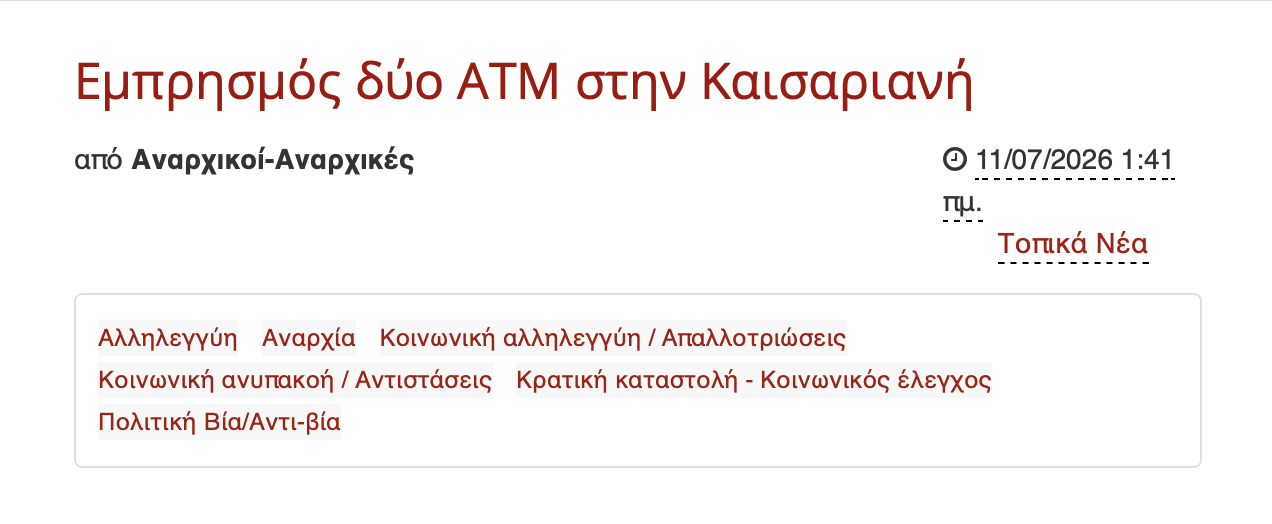
Source: Indy Media
EXECUTIVE SUMMARY
An anarchist cell in Athens, Greece, claimed responsibility on July 29 for destroying two automated teller machines (ATMs) and damaging associated bank branches on Ethniki Antistaseos Street in the Kaisariani neighborhood on the evening of July 8. The communique describes the attack as an act of solidarity for comrades arrested in May following an armed bank robbery and explicitly defends arson as a legitimate political tool.
ANALYSIS
The July 8 attack targeted ATMs belonging to Piraeus Bank and Ethniki Bank (National Bank of Greece) in Kaisariani, a historically working-class neighborhood in eastern Athens with a long history of anarchist and anti-authoritarian organizing. The attackers used incendiary materials to destroy both machines, with the communique describing the burning ATMs as sending 'smoke signals to the comrades in prison.' A three-week gap between the attack and the communique's publication on July 29 is consistent with security tradecraft within Greek anarchist networks, which frequently delay claims to allow time for any physical evidence to degrade.
The stated motivation is solidarity with individuals arrested on May 11 in connection with an armed robbery of a Piraeus Bank branch in Kato Tithorea, a town in central Greece. The communique explicitly links the bank arson to those individuals, dedicating the action to them and framing the destruction of Piraeus Bank ATMs as a direct material response to the prosecution. This pattern, in which incendiary or destructive acts in urban centers serve as solidarity signals for imprisoned comrades, is a well-documented tactic in the Greek anarchist milieu and has analogues in German, Italian, and Spanish networks that maintain active communication with US-based groups.
The communique places the Kaisariani attack within a broader political moment. The group references a wave of arson attacks in Thessaloniki in the week preceding the communique's publication, which triggered statements from the Greek prime minister and other government officials condemning 'left-wing violence' and calling for criminal investigations into the anarchist political space. The communique directly responds to this government posture, framing it as authoritarian criminalization and arguing that the state's language about 'terrorist organizations' and treating protest materials as incendiary devices represents an escalating effort to suppress the entire anti-authoritarian left. The cell argues that revolutionary violence, including arson, must be defended rather than distanced from by the broader movement.
On the same day the communique was published (July 29), Greek counter-terrorism authorities conducted near-simultaneous operations in Athens, Thessaloniki, and Chania. The Anti-Terrorism Service and the Directorate for Combating Organized Crime arrested five individuals, with a warrant issued for a sixth. Two of the Athens arrests were connected to the 2010 arson of Marfin Bank, while three Thessaloniki arrests were linked to an arson at a politician's home. The communique notes that these operations occurred as a 20-year-old in Argos remained brain-dead after being shot in the back of the head by police officers following a vehicle pursuit. The convergence of state violence and counter-terrorism arrests on the date of the communique's publication appears deliberate in its framing, positioning the Greek state as simultaneously enacting violence and suppressing dissent.
The operational and analytical relevance for a US law enforcement audience rests on two vectors. First, Greek anarchist networks are structurally connected to US-based insurrectionary cells through shared publications, translated communiques, and overlapping ideological frameworks. The 'Black August 2026' call for a month of international action and propaganda, referenced in adjacent material on the same publishing platform as this communique, directly solicits participation from allied groups globally, including in the United States. Second, the tactic of incendiary attacks on financial infrastructure as solidarity signals for imprisoned comrades has been replicated in the United States on prior occasions and represents a reproducible model. Fusion center analysts should note the elevated operational tempo signaled by the Thessaloniki arsons, the Kaisariani action, and the simultaneous arrests, and factor this into threat assessments for domestic anarchist-aligned actors through the end of August.
SOURCES
