

Analysts and researchers work with the same open sources everyone else can reach. The difference is what they have to do with them — produce a report, a briefing, or an assessment that other people will read, question, and rely on. That means source material you can cite, provenance you can show, and confidence levels you can defend.
Semper Incolumem provides the collection and verification layer beneath that work. Continuous monitoring across global sources, analyst review before anything is published, and a searchable archive of the same open-source intelligence our analysts work from.
The collection and verification is handled. The analysis stays yours.
What Is Open Source Intelligence Research?
Open source intelligence research is the collection, verification, and analysis of publicly available information to answer a defined question — and, for this audience, to support a product that other people will read and rely on.
It differs from decision-focused intelligence in one significant way: the output is not the end of the process. A security director reads an assessment and acts on it. An analyst reads the same material and writes something new from it — a report for a client, a briefing for an executive team, an assessment that informs an underwriting decision or a policy recommendation. That second use imposes requirements the first does not.
Sourcing has to be traceable. Every finding needs to trace back to something specific. Aggregated summaries with no provenance cannot be defended when someone asks where a conclusion came from.
Verification has to happen upstream. Independent confirmation of every item is the single largest time cost in research work. Analyst review before publication removes most of it.
Confidence has to be explicit. Findings that distinguish between confirmed, probable, and unverified give you something to build on. Assertions without qualification do not.
The archive has to be durable. Longitudinal work depends on material that still exists. If content has been removed, altered, or buried since publication, your ability to establish a pattern depends on whether anyone captured it.
The constraint is rarely access to information. It is the verification burden that stands between raw open-source material and something you can put your name on.
RESEARCH SUPPORT VS. ORGANIZATIONAL MONITORING
Open source intelligence research supplies the collection and verification layer beneath analysis you produce — whatever question you are working on, whoever relies on the answer.
Physical security intelligence is scoped to your own organization. SI monitors the facilities, people, and operations you are responsible for protecting.
Many analysts use both. If your work centers on threats to your own organization, see our physical security intelligence support →.
How Semper Incolumem Supports Open Source Intelligence Research
Research work runs on two tempos. There is the sustained coverage that keeps you current across the geographies, sectors, or threat categories you follow, and there is the concentrated analytical work a specific question demands.
Semper Incolumem supports both through two complementary services.
Ongoing Platform Access
For research programs, continuous collection is the foundation. Rather than forwarding raw alerts, SI delivers structured intelligence with defined assessment statements and identified sources. The verification work is done before the material reaches you.
Platform access includes:
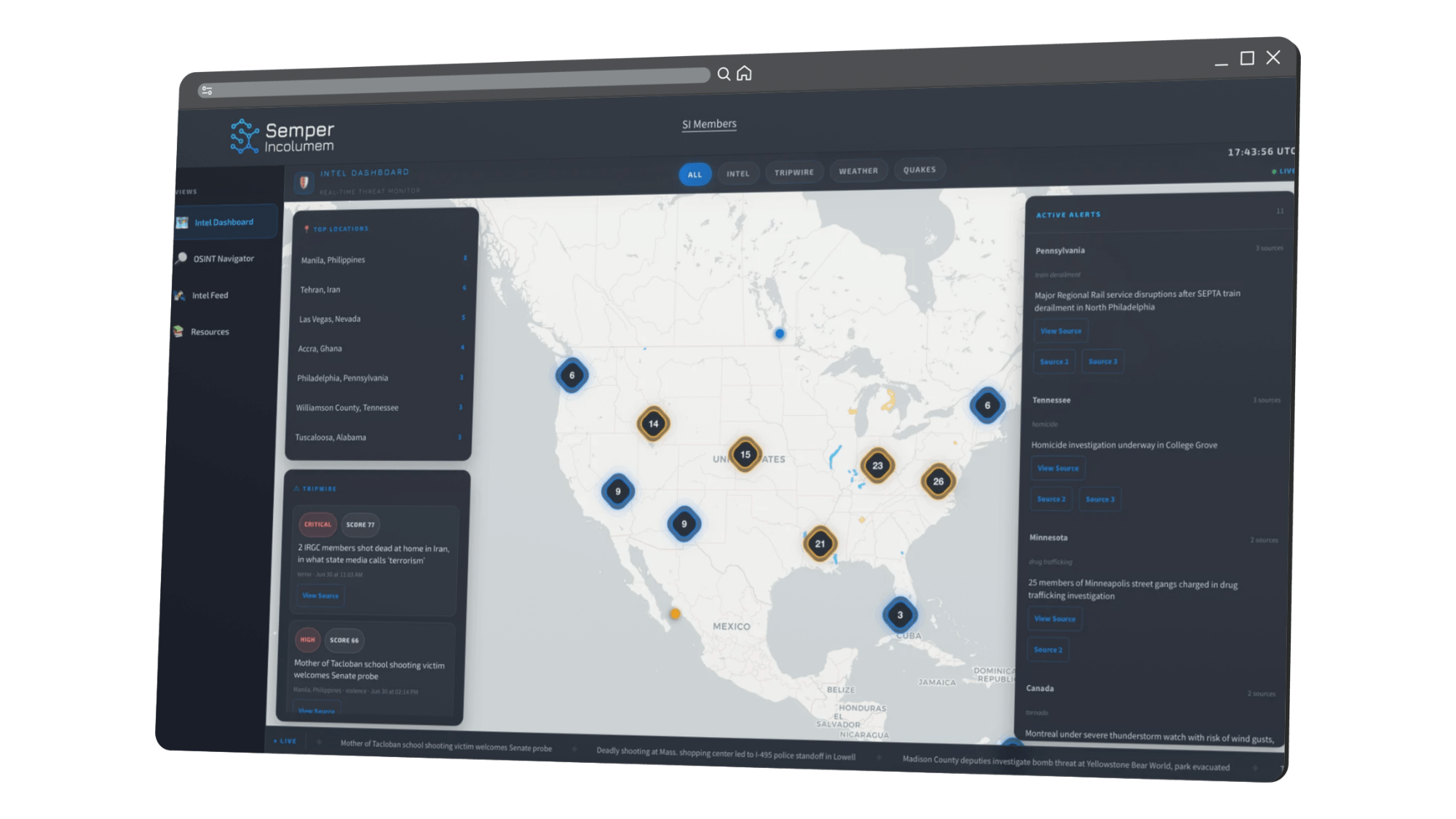
A geo-tagged threat map covering domestic and international incidents, updated continuously from monitored sources
The OSINT Navigator — a searchable research database covering the same open-source intelligence SI analysts work from, retrievable across topics, regions, and timeframes
Analyst-verified intelligence reports, reviewed for source credibility, context, and analytical soundness before publication
Tripwire — proprietary scoring that surfaces the highest-priority signals from the full collection stream
Custom dashboards and priority alerts organized by geography, threat type, or topic
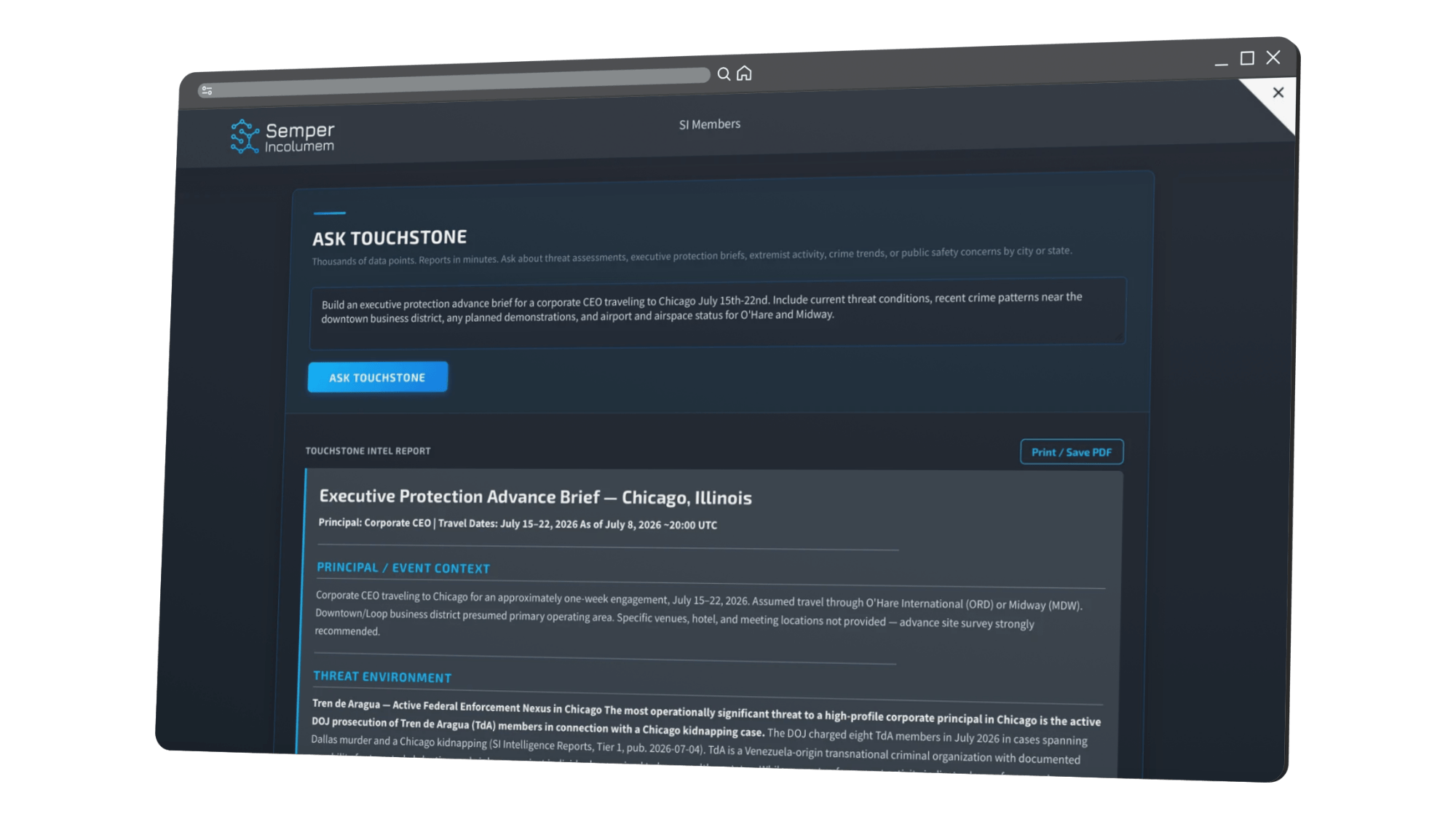
Touchstone AI-assisted research — a sourced, confidence-graded preliminary assessment in minutes, useful for orienting on an unfamiliar region, scoping work before committing to it, or determining whether a question warrants deeper analysis
Platform access supports coverage across the areas you follow, background research for specific assignments, longitudinal pattern analysis, and the preliminary orientation that determines whether a question warrants deeper work.
Commissioned Threat Assessment Reports
Some questions require dedicated analyst work. Custom threat assessment reports address a specific person, location, or event — including individual background research where the assessment question warrants it.
Common use cases for analysts and consultants include:
A question that falls outside your own coverage area or subject-matter depth
Capacity constraints when requests overlap
A specific individual, venue, or event requiring concentrated analysis
Research foundation for a product you deliver under your own name
Independent analysis to corroborate or challenge your own findings
Reports provide consolidated signal analysis, source validation and corroboration, clear separation of fact and assessment, and explicit confidence levels — structured to be cited, briefed, and defended.
Our Open Source Intelligence Research Methodology
Across both services, our methodology is consistent. SI does not replace your analytical judgment. We extend your collection and verification capacity — particularly for analysts who need structured, defensible source material but cannot maintain collection infrastructure for every region or question that comes across the desk.
01
Verification Before Reporting
No unvalidated signals passed to the client as findings. Every intelligence product reflects confirmed information, not raw open-source volume.
02
Fact vs. Assessment
Clear delineation between what is known, what is inferred, and at what confidence level — so the client understands the basis for every finding.
03
Operational Relevance Over Volume
The product contains what matters to your question. Not everything that could be included — everything that warrants attention.
04
Transparent Sourcing
Every finding is traceable and documentable. Products are built to be defended in briefings, after-action reviews, and client presentations.
05
No Sensationalism
Threat indicators are assessed on their merits, not amplified for effect. The goal is accurate calibration, not urgency for its own sake.
06
Analyst Judgment Throughout
SI does not sell unfiltered alert feeds or pass raw aggregation off as analysis. Analyst judgment shapes every product, from the curated collection Touchstone draws on to the finished assessments an analyst produces, and machine-generated output is always labeled for what it is: a preliminary starting point, not finished intelligence.
INTELLIGENCE ANALYSIS TRAINING
Formalize Your Open Source Intelligence Research Methodology
Applied OSINT for Security Professionals is a practitioner-led virtual training for analysts, consultants, and researchers who want a documented, repeatable methodology behind their open-source work.
Participants leave with repeatable intelligence workflows, a written OSINT SOP, and a vetted tool stack — built around the same methodology SI applies in live client engagements. Four to six hours, delivered virtually with a live instructor.
Analyst and Researcher FAQs
-
Reports identify their sources, and platform access is intended to support your own analytical work. Review your subscription terms for specifics on redistribution and attribution.
-
Coverage depends on the topic and region. The archive grows continuously as collection proceeds and is most complete for the geographies and threat categories under active monitoring.
-
Individual access starts at $35 per month or $350 per year, with no contracts and no enterprise minimums. Platform + Touchstone is $1,000 per year.
-
A feed delivers volume and leaves triage and verification to you. Semper Incolumem applies analyst review before publication and Tripwire prioritization across the stream, so the material arriving has already been evaluated for credibility and significance.
-
Yes. Custom threat assessment reports are available for specific people, places, or events when a particular question requires dedicated analyst work rather than ongoing monitoring.
-
Yes. Applied OSINT for Security Professionals covers collection methodology, verification standards, and analytical tradecraft.
Explore Other Areas We Serve
RELATED INTELLIGENCE SUPPORT
Physical Security Intelligence
For programs covering facility, campus, and event security alongside principal protection.
LEARN MORE →
Public Safety Intelligence
For law enforcement and emergency management professionals who need location-specific, verified intelligence.
LEARN MORE →
Choose the Intelligence Support That Matches Your Mission
GET STARTED
ONGOING RESEARCH ACCESS
OSINT Platform
For continuous collection, a searchable archive, and analyst-verified reporting you can cite and build on — with Touchstone for preliminary assessments on research timelines. Individual subscriptions, monthly or annual.
COMMISSIONED ANALYSIS
Threat Assessment Reports
For a specific person, location, or event when a research question requires dedicated analyst work — whether the assessment is your deliverable or the foundation for one.