

Introducing Tripwire: Threat Prioritization Built for Analysts
Every analyst knows the feeling. You open the dashboard. The data is current, the feeds are running, and somewhere in the volume in front of you is the incident that matters. The problem is finding it before it finds you.
That’s the problem Tripwire is built to solve.
Tripwire is Semper Incolumem’s threat prioritization engine — a feature of the OSINT Platform that automatically scores incoming data by relevance and surfaces the incidents that most demand immediate attention. Instead of sorting through hundreds of data points, analysts get a curated shortlist: typically around ten high-signal incidents that are most likely to drive decisions, generate follow-on reporting, or require immediate awareness.
The Problem Isn’t Data. It’s Signal.
Intelligence workflows don’t fail because of a lack of information. They fail because of too much of it arriving at once. Suspicious activity reports, bulletins, open-source feeds, requests for information, internal reporting streams — often all hitting simultaneously, with no clean mechanism to separate what’s urgent from what can wait.
Even well-filtered data isn’t the same as prioritized data. You can narrow a feed and still end up staring at a map with far too many points to act on quickly. When that happens, the information is there, but it isn’t intelligence. It’s inventory.
At Semper Incolumem, we encountered this directly while developing our Threat Dashboard. The platform was strong at coverage. What it needed was a sharper answer to the simplest question analysts ask: what do I need to look at right now?
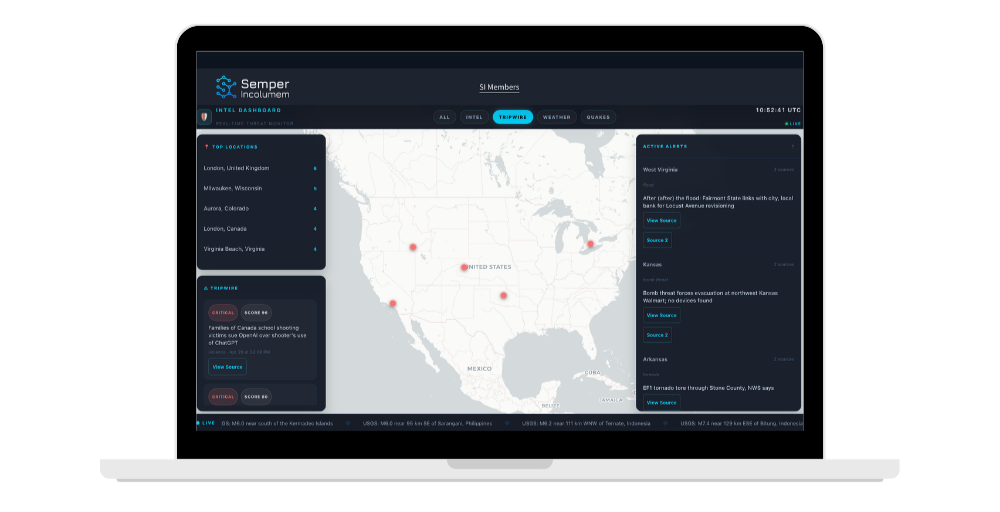
Tripwire filters the noise. The Intel Dashboard's Tripwire view surfaces only the highest-scoring incidents — so analysts spend time on decisions, not sorting.
How Tripwire Works
Tripwire assigns each incoming data point a threat-relevance score based on severity indicators, targeting signals, and other high-impact factors. Only the strongest signals rise to the top.
On the Threat Dashboard, a single click transforms the map from a broad collection layer into a focused operational view. The result isn't a filtered-down version of everything; it’s a prioritized shortlist of the incidents most likely to require action.
The scoring draws on the same analytical logic experienced analysts apply instinctively. Tripwire applies it systematically, at the speed and scale that human triage alone can’t consistently match. It doesn’t replace analyst judgment. It clears the runway for it.
Who Tripwire Is Built For
Threat prioritization isn’t a single-audience problem. Across SI’s core client base, the underlying challenge is the same — too much coming in, not enough time to assess it all — but the operational stakes look different depending on the role.
Corporate Security and Risk Teams
For security directors managing enterprise risk, Tripwire reduces the window between a relevant incident and an informed decision. When a situation develops near a facility, a traveling executive, or a key event, the platform surfaces it without requiring manual triage of everything else in the feed.
Executive Protection Professionals
EP professionals operating in dynamic environments need threat awareness that keeps pace with movement. Tripwire’s prioritization means the incidents that matter to a specific principal’s location or itinerary rise above background noise, giving protection teams the signal they need without the overhead of full-feed monitoring.
Law Enforcement and Public Safety
For LE analysts already managing competing demands on attention, Tripwire reduces the triage burden on incoming intelligence. It doesn't replace analytical judgment. It compresses the time required to identify which incoming information warrants that judgment.
Intelligence Analysts and Researchers
For analysts working across broad topic areas or geographic regions, Tripwire functions as a first-pass filter that respects their time. It handles the volume problem so analysts can spend their hours on synthesis, assessment, and reporting — not sorting.
Frequently Asked Questions
Does Tripwire replace analyst review?
No. Tripwire is a prioritization tool, not an autonomous decision system. It identifies which incoming data points warrant immediate analyst attention — the analysis itself remains in analyst hands.
How does Tripwire determine what rises to the top?
Each data point receives a threat-relevance score based on severity indicators, targeting signals, and other high-impact factors built into SI's scoring methodology. The highest-scoring incidents surface to the top of the prioritized view.
Is Tripwire available on all Intelligence Platform subscriptions?
Tripwire is a feature of the Semper Incolumem OSINT Platform. For current subscription details and access, contact us or explore the OSINT Platform.
What’s the difference between a filtered feed and Tripwire’s prioritized view?
Filtering removes data points that don't meet a set criterion. Prioritization ranks what remains by operational relevance. Tripwire does the latter. It doesn't just reduce volume. It orders what’s left by what matters most.
