

What Is a Threat Assessment? A Guide for Security Professionals
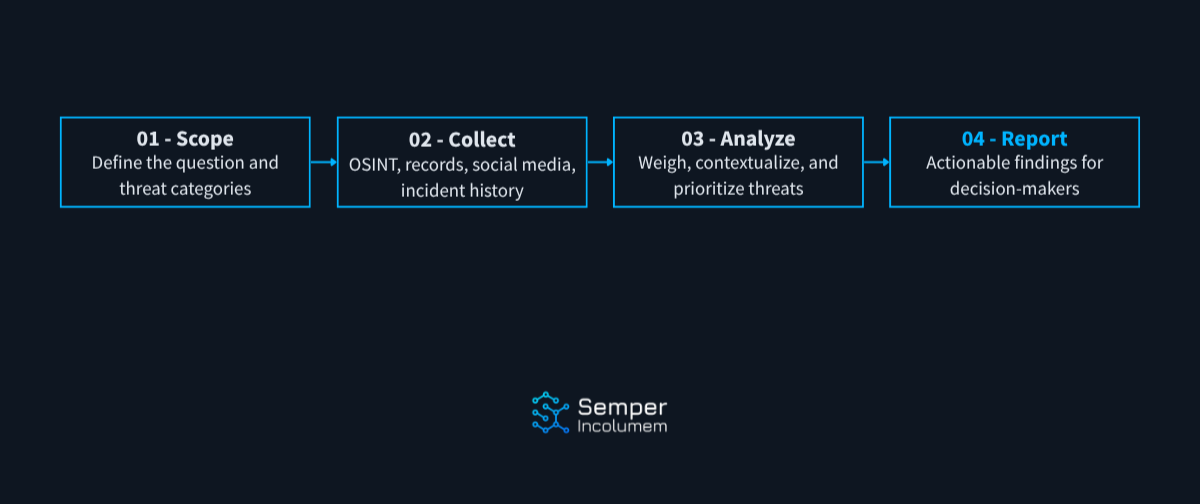
A threat assessment is a structured analytical process for identifying, evaluating, and prioritizing threats to a specific person, place, organization, or event. Its purpose is not to catalog everything that could go wrong, but to produce a prioritized, decision-relevant picture of which threats are most likely and most consequential in a specific context.
Security professionals use the term constantly, but its meaning varies widely depending on who's using it. A threat assessment can refer to a 30-minute checklist or a multi-week analytical process. Understanding what a rigorous threat assessment actually involves, and what distinguishes a professional one from a generic risk framework, matters for anyone relying on that output to make protective decisions.
This article defines threat assessment as a discipline, breaks down how a structured assessment is conducted, and explains when organizations and individuals need one.
Defining Threat Assessment
Done well, a threat assessment answers three questions:
What threats exist in this environment?
Which of those threats are credible given the available evidence?
Which threats warrant immediate attention versus ongoing monitoring?
The answers to those questions inform protective decisions — staffing, route planning, venue selection, event security protocols, executive travel authorization. A threat assessment that doesn't connect to a decision isn't serving its purpose.
What Separates a Professional Threat Assessment from a Checklist
Many organizations use standardized risk frameworks and call the output a threat assessment. These tools have their place, but they share a structural limitation: they assess categories of risk rather than specific, context-driven threats. A checklist can tell you that a venue has inadequate lighting in a parking structure. It cannot tell you that a specific individual with a documented grievance and a pattern of escalating behavior is likely to appear at your event.
A professional security threat assessment requires analyst judgment — someone trained to evaluate source credibility, identify behavioral indicators, weight evidence, and produce a prioritized picture that accounts for context rather than just general risk factors. The difference is methodological, not cosmetic.
Analyst-led threat assessments draw on open-source intelligence (OSINT), law enforcement records, social media monitoring, and other available sources. The analyst's role is not to collect that data. It is to interpret it, recognize what it means in context, and communicate findings in a way that supports a specific decision. For organizations evaluating how physical security intelligence fits into a broader protective program, the same methodology applies: collection without interpretation is not intelligence.
The Core Components of a Threat Assessment
1. Scope Definition
Every sound threat assessment begins with a clearly defined scope: What person, location, or event is being assessed? Over what time horizon? Against what threat categories — targeted violence, protest disruption, theft, insider threat, or something else? Scope definition prevents the assessment from becoming a sprawling risk audit and keeps the analysis tied to actionable decisions.
2. Intelligence Collection
With scope established, analysts identify and collect relevant information. For a corporate threat assessment, this might include reviewing public records, monitoring social media for emerging threats related to the organization or its executives, canvassing protest activity in the relevant geography, or reviewing incident history at a specific venue. The collection phase is disciplined — not a data dump, but a targeted effort to gather information that is actually relevant to the defined scope.
3. Analysis and Prioritization
This is where professional methodology earns its weight. Raw information becomes intelligence only when an analyst evaluates it: Is this source credible? Does this behavioral indicator represent an escalation pattern or an isolated incident? Does this threat have the intent, capability, and opportunity to act? Prioritization is the output of this step — a ranked picture of which threats demand immediate attention and which warrant monitoring. The Tripwire feature in SI's Intelligence Platform applies this prioritization logic automatically, surfacing only the highest-priority signals from the full intelligence stream.
4. Reporting and Recommendations
A threat assessment report translates analysis into decision-relevant output. A well-constructed report documents the threat picture, explains the analytical basis for prioritization, and provides specific, actionable recommendations. Vague conclusions (“exercise caution” or “maintain awareness”) are not useful. Recommendations should be specific enough that a security director or executive protection lead can act on them directly.
5. Ongoing Monitoring or Follow-up
Many threats are not static. An individual of concern may de-escalate or escalate. A geopolitical development may shift the threat picture for executive travel. A well-structured threat assessment program includes mechanisms for ongoing monitoring and updated analysis as conditions change. The Semper Incolumem OSINT Platform is built around exactly this function: continuous analyst-driven monitoring that updates the threat picture as the environment evolves.
What Triggers a Threat Assessment
The clearest use cases are those where a specific, near-term decision depends on understanding the threat picture:
Executive travel to a high-risk geography or politically unstable region
Corporate events, public appearances, or shareholder meetings with protest or targeted violence potential
Workplace situations involving an individual of concern — a terminated employee, a threatening communication, or escalating behavior
Site selection or venue evaluation for high-profile principals
Pre-acquisition due diligence on a company operating in a complex security environment
Organizations also commission threat assessments as a component of their baseline security posture, establishing a documented understanding of the threat environment before an incident occurs rather than in response to one.
Analyst-Led vs. Automated Threat Assessment
Software platforms have made it easier to aggregate and flag open-source information. Some of these tools are useful for triage and situational awareness. None of them replace the analytical step.
A threat assessment that relies on automated alerts and keyword monitoring will surface volume. It will not reliably surface significance. An analyst evaluating the same data set will ask different questions — about source reliability, about behavioral context, about what the pattern means given everything else that's known. That interpretive layer is what makes a threat assessment defensible and actionable.
For decisions with serious consequences — executive safety, large-scale event security, organizational threat management — analyst judgment is not a premium add-on. It is the methodology.
Commission a Professional Threat Assessment
Semper Incolumem produces custom threat assessment reports for individuals, organizations, and events. Every assessment is conducted by experienced analysts using open-source intelligence tradecraft and structured analytical methodology. The output is a clear, decision-ready report, not a data export.
If you have a specific person, location, or event that needs assessing, request a threat assessment to discuss scope and timeline.
