

Iran War 'Tax' Measurable on US Households; Pew: 69% of Americans Cite Gas Prices as Top Conflict Concern; J.P. Morgan Warns $5 Gallon Within Weeks
Source: Pew Research Center
EXECUTIVE SUMMARY
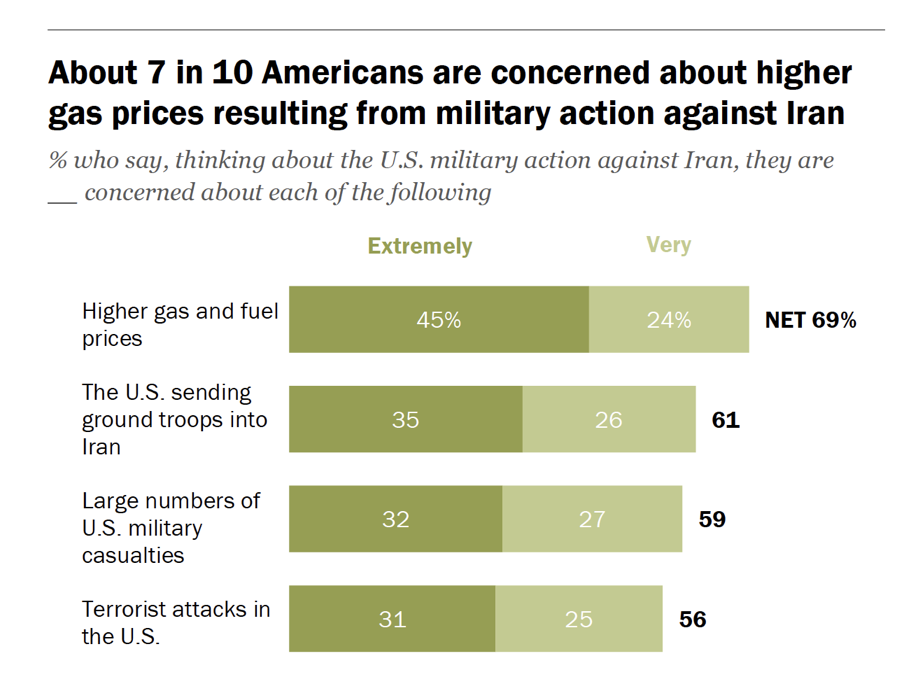
A Pew Research Center survey released April 7 found that 69 percent of Americans cite higher gas prices as their top concern from the Iran war, with gas now averaging $4.12 per gallon nationally, up 38 percent from the $2.98 pre-war average. Diesel has climbed faster, reaching $5.62 per gallon, a 49 percent increase. West Texas Intermediate crude closed at $115.48 per barrel on April 6, with Brent approaching $112. J.P. Morgan analysts warned this week that gasoline could exceed $5 per gallon if the Strait of Hormuz remains closed through mid-April. Amazon and JetBlue added fuel surcharges this week, the first major US consumer-facing companies to formally pass conflict-related energy costs to customers.
ANALYSIS
The Pew data, drawn from a March 23-29 survey of 3,507 US adults, is the clearest single indicator of the conflict's domestic political vulnerability. A 69 percent majority citing gas prices as their primary concern exceeds the proportion citing military casualties, terrorist attacks on US soil, or the war expanding regionally, each of which scored lower. This ordering matters for intelligence assessment: public tolerance for the conflict is most directly correlated with fuel costs, meaning any sustained increase in gas prices compresses the political window for continued operations more reliably than casualty counts or diplomatic isolation.
The supply disruption driving prices is structural. Gulf Arab states shut in an estimated 7.5 million barrels per day in March with the figure expected to rise to 9.1 million barrels per day this month as the Hormuz closure extends. Approximately 200 commercial vessels have been displaced from normal Hormuz routing to the Cape of Good Hope, adding 10 to 20 days to transit times and spiking US import freight rates by up to 50 percent. Senate Democrats calculated the war has already cost American consumers approximately $8.4 billion in elevated gas prices.
The Energy Information Administration projects a national gas price peak of $4.30 per gallon this month under current conditions. J.P. Morgan's $5 threshold, if reached, would represent the highest US retail gasoline price in memory and would produce significant political pressure for resolution. Macquarie Group's scenario analysis goes further, projecting $200 per barrel and $7 per gallon gasoline if the conflict extends through summer, a price level that would trigger recessionary effects and fundamentally alter the domestic political calculus on the war.
The Amazon and JetBlue surcharge announcements are early signals of broader economy-wide cost pass-through. As freight rates, jet fuel, and diesel costs flow through supply chains over the next 60 to 90 days, US consumer prices for a wide range of goods will reflect the conflict's energy premium. Paper and board markets are already reporting disruption driven by the oil shock. Nitrogen and aluminum supply chain stress is emerging. The Federal Reserve is monitoring conflict-generated inflation as a distinct policy variable. For law enforcement, the consumer-cost angle is a direct driver of public sentiment, protest motivation, and political pressure on administration decision-making.
SOURCES
Pew Research Center: Gas Prices Are Americans' Top Iran War Concern (April 7, 2026)
CNBC: US-Iran war 'tax' begins to hit American businesses and consumers
CBS News: US benchmark WTI climbed to $115.48 per barrel on April 6
Black America Web: Senate Democrats Estimate Iran War Cost Americans $8.4B In Gas Prices
The Hill: Gas prices concern Americans most amid Iran war: Pew survey
