

ISIS Pashto Media Publishes Message Claiming Global Expansion and Mocking Reports of the Group’s Defeat
Executive Summary
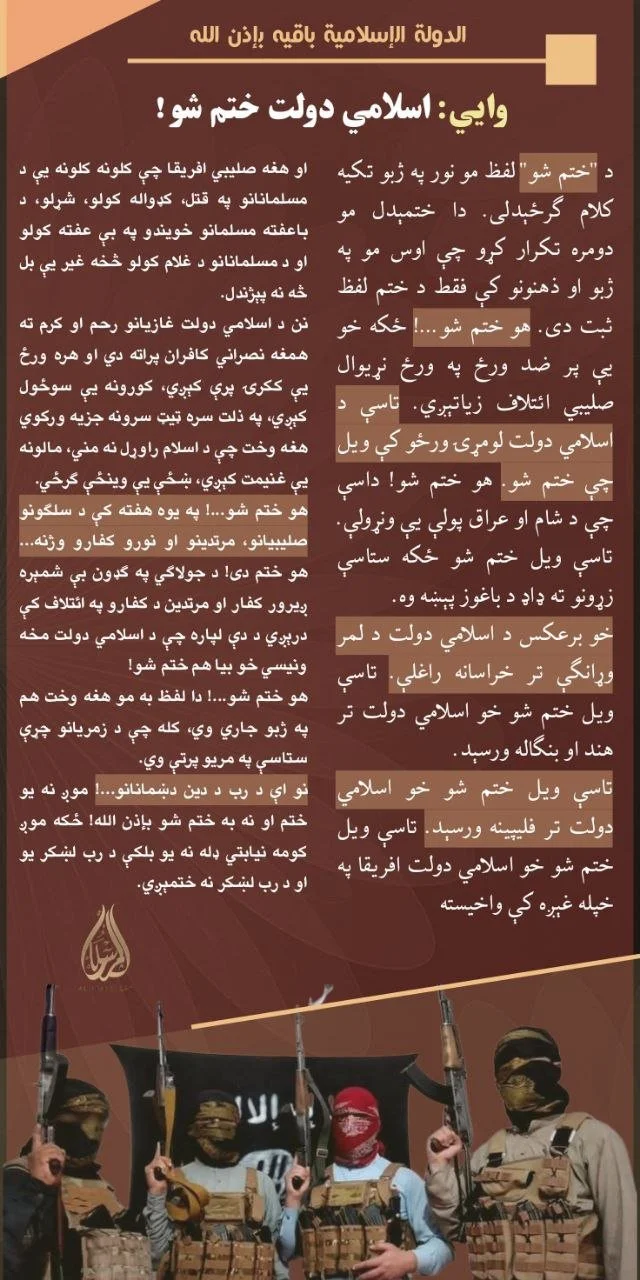
An ISIS-aligned Pashto-language media channel released a new graphic message dismissing claims that the Islamic State has been “ended” and asserting that the group has instead expanded worldwide. The propaganda highlights ISIS activity in Iraq, Syria, Africa, the Philippines, and Khorasan, mocking global coalitions and governments that previously declared victory. The message attempts to reassure supporters, reinforce ideological commitment, and project organizational resilience despite losses.
Analysis
The latest Pashto propaganda frames recent claims about ISIS’s defeat as lies and uses a global narrative to portray the movement as strong, expanding, and divinely protected. This rhetorical strategy is consistent with earlier ISIS media messaging aimed at countering perceptions of decline and encouraging supporters to remain committed.
The graphic mocks declarations that ISIS has been “finished,” insisting that the group remains present in Iraq and Syria and arguing that the Islamic State “never ended.”
It claims the “Islamic State first ended you,” directing this message at Western and Muslim-majority governments that fought ISIS and ridicules coalition operations across Iraq and Syria.
The statement highlights ISIS branches in Africa, calling the continent “taken” by the organization, and names the Philippines and Khorasan as examples of areas where ISIS allegedly grew after being declared defeated.
The message concludes by asserting that the “Islamic State has reached Africa and beyond” and that the movement continues to expand globally, presenting this as proof that “the State did not end.”
This propaganda reflects a common ISIS narrative: defeats are temporary tests, territorial losses are irrelevant to the group’s legitimacy, and expansion into weakly governed regions demonstrates continued viability. The use of Pashto suggests targeting audiences in Afghanistan and Pakistan during a period of heightened ISIS-K activity, which aligns with the group’s increasing emphasis on Khorasan as a core theater.
