

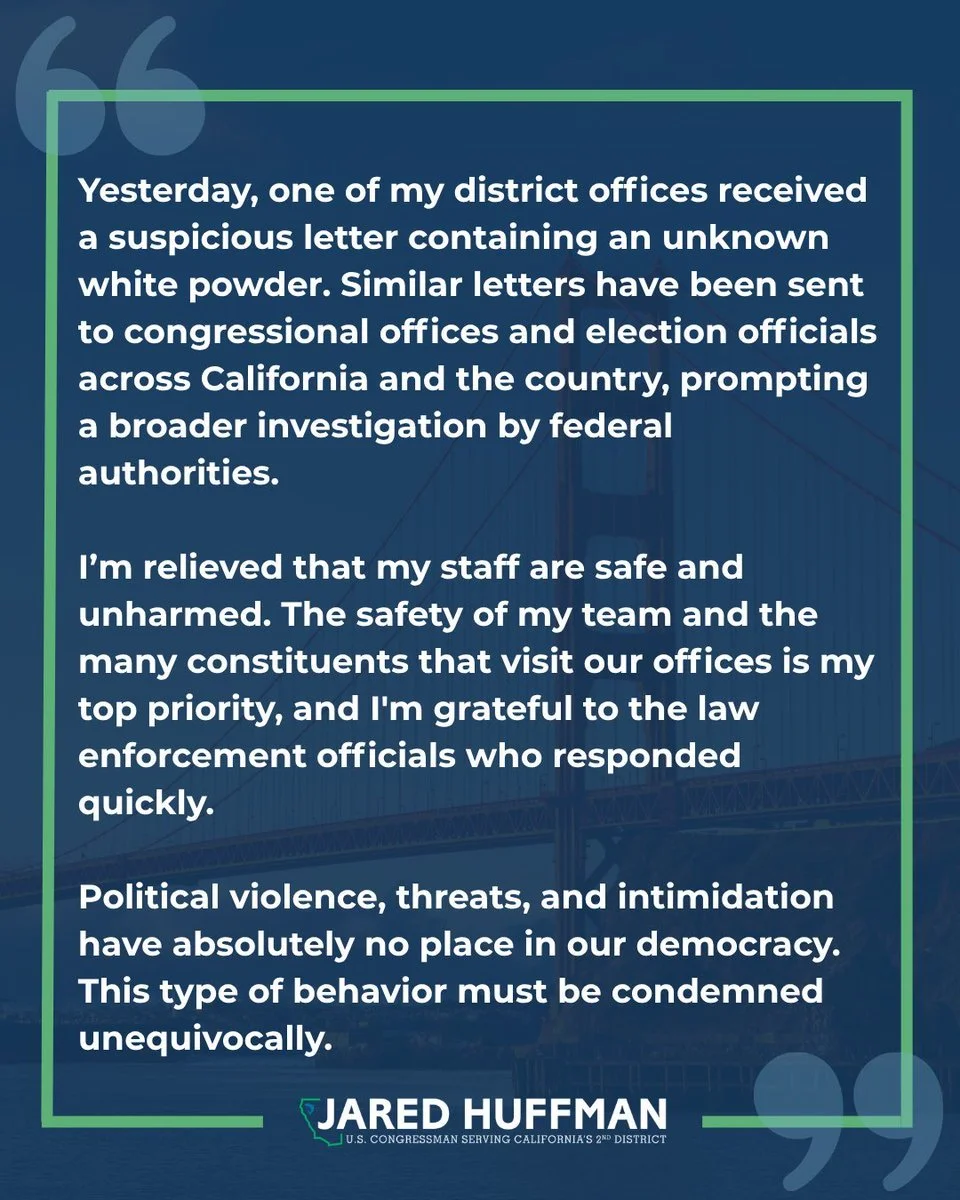
Source: X | @RepHuffman
EXECUTIVE SUMMARY
An ongoing campaign of threatening letters containing unidentified white powder reached more than three dozen congressional offices and secretary of state offices across the United States as of October 20. The FBI and U.S. Postal Inspection Service are investigating what appears to be a coordinated effort tied to the November 2026 elections. All substances tested to date have been non-hazardous, and no suspect has been publicly identified.
ANALYSIS
The white powder letter campaign expanded between October 19 and October 20. At least three dozen lawmakers have now reported receiving suspicious mailings. Emergency personnel responded to Sen. Deb Fischer's West Omaha field office around 1 p.m. October 20 after staff found an envelope containing an unidentified powder. Fischer is the third Nebraska political figure in recent days to receive such a letter. The FBI assumed jurisdiction and is testing the substance.
Rep. Al Green's Houston district office received a powder-filled envelope postmarked from San Antonio and dated October 13. Green held a press conference Monday to address the incident, saying his office would not be intimidated. A separate suspicious powder envelope was received at Sen. Ted Cruz's Houston office on Friday. Colorado saw at least four separate incidents involving state lawmakers, with the FBI opening a concurrent investigation covering those cases. Rep. Mike Thompson's Napa, California office was also targeted on October 20.
All substances analyzed to date have tested non-hazardous. Confirmed targets include Senate Minority Leader Chuck Schumer, Sens. Alex Padilla, Pete Ricketts, and Ted Cruz, Rep. Al Green, Rep. Mike Thompson, and multiple Colorado state legislators. The campaign extends beyond elected offices to secretary of state and other election administration offices in multiple states, a pattern that points toward interference with election infrastructure rather than threats directed only at individual lawmakers.
Congressional staff responding to suspicious mail follow Capitol Police protocols: isolate the envelope, contact security, and await hazmat evaluation. The volume of incidents across more than three dozen offices in a single campaign is straining those response systems in the final weeks before the November 2026 election. The targeting of election administration offices alongside elected officials points toward a dual objective: threatening lawmakers while disrupting the administrative machinery of the election itself.
SOURCES
