

Wildfire Smoke Drives Hazardous Air Quality for 124 Million Americans Across 12 States
Source: AirNow.gov
EXECUTIVE SUMMARY
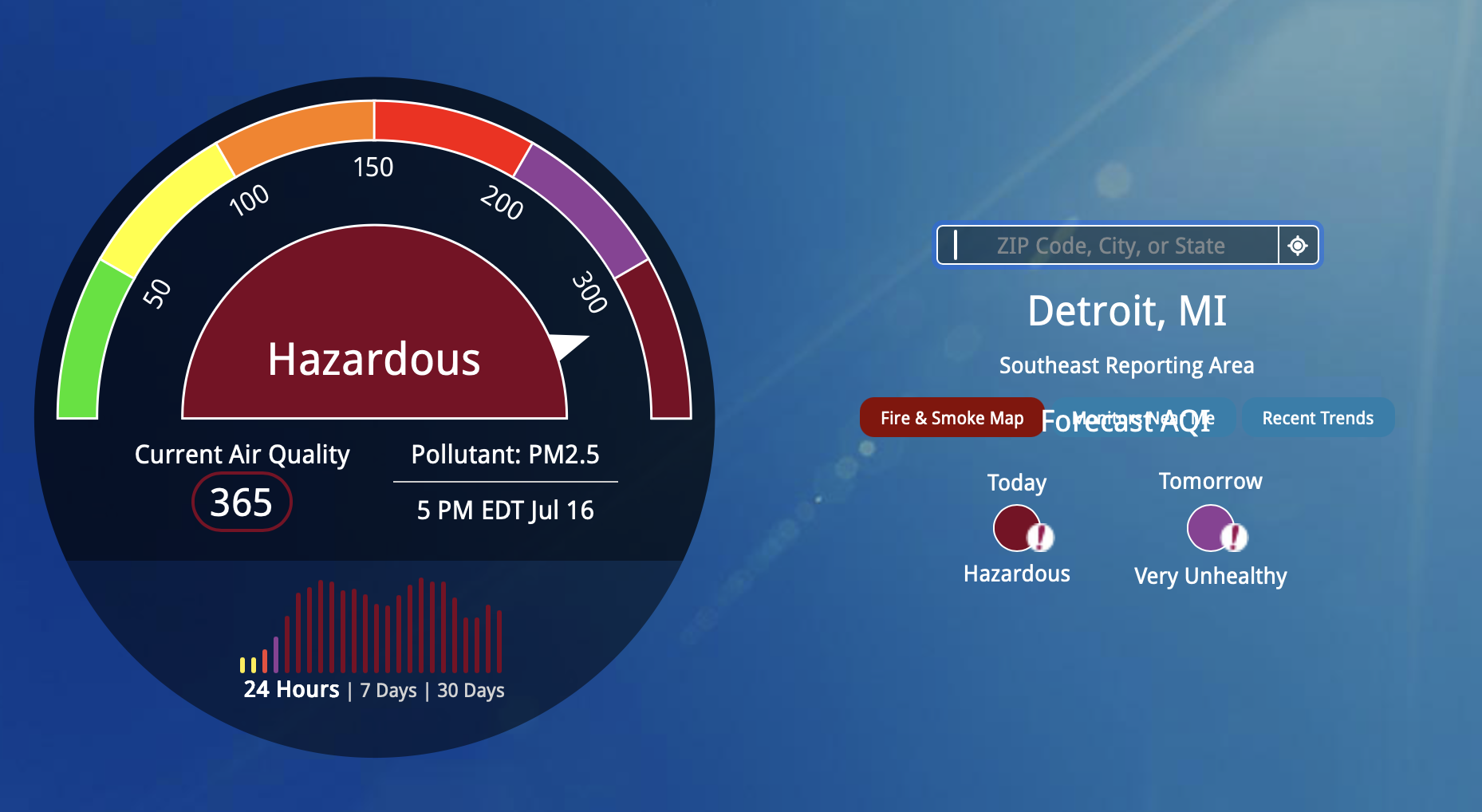
Smoke from more than 100 active wildfires in Canada and Minnesota blanketed the Midwest and Northeast United States beginning July 14, triggering statewide Air Quality Alerts across Michigan, Wisconsin, and Pennsylvania, closing courts and schools, and exposing an estimated 124 million people to hazardous or very unhealthy air pollution levels extending through at least July 17.
ANALYSIS
More than 100 wildfires burning in Ontario, Quebec, and northern Minnesota generated smoke plumes that began tracking southeast on July 14, reaching the Upper Midwest by morning and spreading into the Northeast and Mid-Atlantic corridor by July 15. The Michigan Department of Environment, Great Lakes, and Energy (EGLE) issued a statewide Air Quality Alert on July 14 that was extended through July 16. The Air Quality Index in Duluth, Minnesota reached 902 on July 15, well above the 300 threshold classified as "Hazardous" on the federal scale, at which outdoor exposure is dangerous for all populations including healthy adults. Detroit, Minneapolis, and Chicago ranked among the five most polluted major cities globally on July 15 and 16 by IQAir monitoring data.
Public safety and critical infrastructure disruptions accumulated throughout the event window. Wayne County Third Circuit Court in Michigan, one of the busiest courts in the country, canceled all proceedings on both July 15 and July 16. Monroe County public schools canceled summer programs and athletic activities. Pennsylvania issued a Code Red air quality alert statewide. New York metropolitan area alerts included New York City. A Newsweek analysis mapped 12 states under formal Air Quality Alerts as of midday July 16.
The public health burden from this event is substantial. Fine particulate matter (PM2.5) in wildfire smoke penetrates into lung tissue and enters the bloodstream, creating cardiovascular and neurological risks beyond the respiratory effects associated with conventional urban air pollution. Stanford researchers studying wildfire smoke have characterized it as approximately 10 times as toxic per unit as standard urban particulate pollution. Children, the elderly, and individuals with asthma or cardiovascular conditions face the highest risk, though Canadian wildfire smoke events in 2023 demonstrated measurable acute cardiorespiratory effects in healthy adults after several days of sustained exposure.
Emergency response agencies in affected states have relied primarily on public advisories and school closure guidance. The geographic scope of the event, spanning 12 states over several days, exceeds most municipal outdoor air contingency frameworks. Law enforcement agencies in the affected corridor should anticipate elevated medical emergency call volumes, increased hospital emergency department utilization, and potential absenteeism among uniformed personnel and support staff. Correctional facilities with outdoor inmate programming and probation and parole reporting requirements involving outdoor queuing or public transportation should consider temporary operational modifications.
The Canadian and Minnesota source fires are not forecast to be fully contained within the current briefing cycle. Prevailing wind patterns are expected to sustain southward smoke transport through at least July 17 before any significant directional shift. The event carries no federal disaster declaration; state environmental emergency frameworks are managing the response at the state level. No Federal Emergency Management Agency (FEMA) or U.S. Environmental Protection Agency (EPA) emergency coordination activation had been announced as of publication.
SOURCES
