

Berlin Anarchist Arson Targets Deutsche Telekom Over NATO Defense Contracts
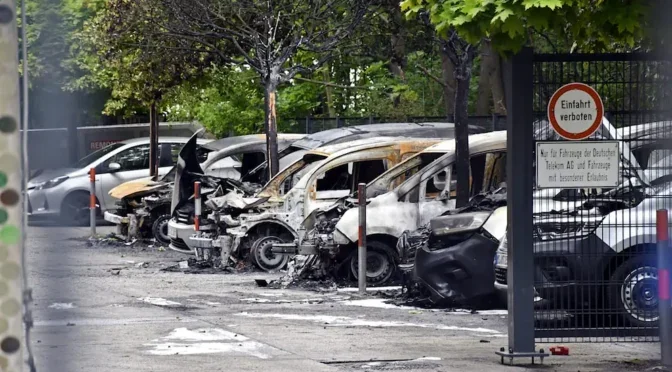
Source: actforfree.noblogs.org
EXECUTIVE SUMMARY
An anonymous anarchist cell claimed responsibility for burning six Deutsche Telekom vehicles in Berlin's Alt-Hohenschonhausen neighborhood overnight on August 20 to 21, citing the telecommunications firm's commercial relationship with arms manufacturer Rheinmetall as the motive. The attack is the latest in a documented and accelerating wave of anti-militarist direct action across North Atlantic Treaty Organization (NATO) and European Union member states, targeting companies perceived as enabling Europe's defense industry expansion.
ANALYSIS
Six commercial vehicles belonging to Deutsche Telekom were set on fire in Alt-Hohenschonhausen, a neighborhood in eastern Berlin, in the early hours of August 21. The action was claimed the following morning on actforfree.noblogs.org, the primary English-language platform for international anarchist direct action claims. The cell framed Deutsche Telekom as a war profiteer and cited the company's commercial relationship with Rheinmetall, Germany's largest defense and munitions manufacturer, as the basis for the attack. Rheinmetall has rapidly expanded its contracting base since Russia's 2022 invasion of Ukraine, and several major German technology and communications firms have entered defense-adjacent supply agreements in support of Germany's rearmament program. No arrests have been reported.
The Alt-Hohenschonhausen attack is consistent in method, framing, and targeting logic with a series of direct action incidents documented across NATO and European Union member states over the past two years. Among the most operationally significant predecessors was the February 7, 2026 coordinated sabotage of Italian railway infrastructure near Bologna, in which an anarchist group disrupted service during the first day of the Winter Olympics and issued a manifesto framing the action as resistance to the military-industrial complex. Earlier in 2026, anarchists in Athens burned automated teller machines in the Kaisariani district on August 4 in an anti-state solidarity action. January 2026 saw arson attacks on power cables in Berlin's Lichterfelde neighborhood that temporarily disrupted the local power grid. The Deutsche Telekom incident extends this timeline without any apparent slowdown in the operational tempo.
The targeting logic emerging from this pattern is analytically specific. Actors are no longer restricting themselves to government property or police infrastructure. The expanded target universe now encompasses any company with visible connections to defense contracting, military logistics, or security technology. Deutsche Telekom's Rheinmetall partnership made it a legitimate target under this framework. The same logic applies to US-headquartered or US-majority-owned companies operating in Europe with active defense contracts, including major technology, cybersecurity, and communications firms with NATO-related work.
Anti-militarist anarchist networks in Germany, France, Greece, and Italy maintain documented connections to counterparts in the United Kingdom and North America through shared publication platforms, encrypted communications, and in-person organizing at international gatherings. actforfree.noblogs.org, where the Deutsche Telekom claim appeared, is actively read and cross-posted on US-based anarchist social media and encrypted forums. The Berlin arson will circulate as an aspirational reference within the anti-militarist milieu within days of publication. The specific claim, that a major telecommunications company is culpable as a defense partner, provides a reproducible targeting rationale that actors in any NATO country can apply to companies in their own jurisdiction.
In the United States, the analogous target universe includes defense contractors with NATO or Ukraine-related contracts, telecommunications infrastructure firms with Department of Defense relationships, and logistics companies moving military freight. All are present in major metropolitan areas and industrial corridors. Vehicle fleet arson is low-cost, operationally simple, and generates disproportionate media coverage. It requires no explosives, no specialized knowledge, and no advance coordination with a larger network, which makes it viable for small cells and individuals without prior direct action experience.
Alt-Hohenschonhausen was not selected randomly. The neighborhood has limited closed-circuit television (CCTV) coverage outside of transit corridors, which would have been identifiable to anyone conducting basic pre-operational surveillance. The six-vehicle scope of the attack indicates a level of advance planning that goes beyond opportunism. German domestic intelligence, the Bundesamt fuer Verfassungsschutz, has been tracking the anti-militarist current within the broader anarchist scene as a distinct and growing area of concern. The absence of arrests in this case is consistent with the low-surveillance environment and the operational discipline the group demonstrated.
September and October have historically been periods of elevated direct action activity across Europe, coinciding with the academic calendar restart and several significant dates in anarchist and anti-capitalist organizing culture. US fusion centers and federal partners with visibility into domestic anti-militarist networks should monitor for calls to replicate the Deutsche Telekom tactic against US defense contractors or telecommunications infrastructure in the months ahead. The ease of replication and the documented ideological alignment between European and US anti-militarist networks makes this a credible near-term inspiration risk, not a theoretical one.
SOURCES
