

Category 5 Hurricane Polo Drives Compounding California Emergency Declarations
Source: X | @zoom_earth
EXECUTIVE SUMMARY
Hurricane Polo reached Category 5 strength on September 22, 2026, with maximum sustained winds of 160 miles per hour while tracking northward off Mexico's Pacific coast. California Governor Gavin Newsom declared a statewide emergency ahead of a forecast extreme El Nino season, and Long Beach separately declared a local emergency following prior damage from Hurricane Marie. Public safety agencies across Southern California are managing concurrent rip current risks, coastal flood warnings, and inter-agency coordination requirements driven by compounding weather emergencies.
ANALYSIS
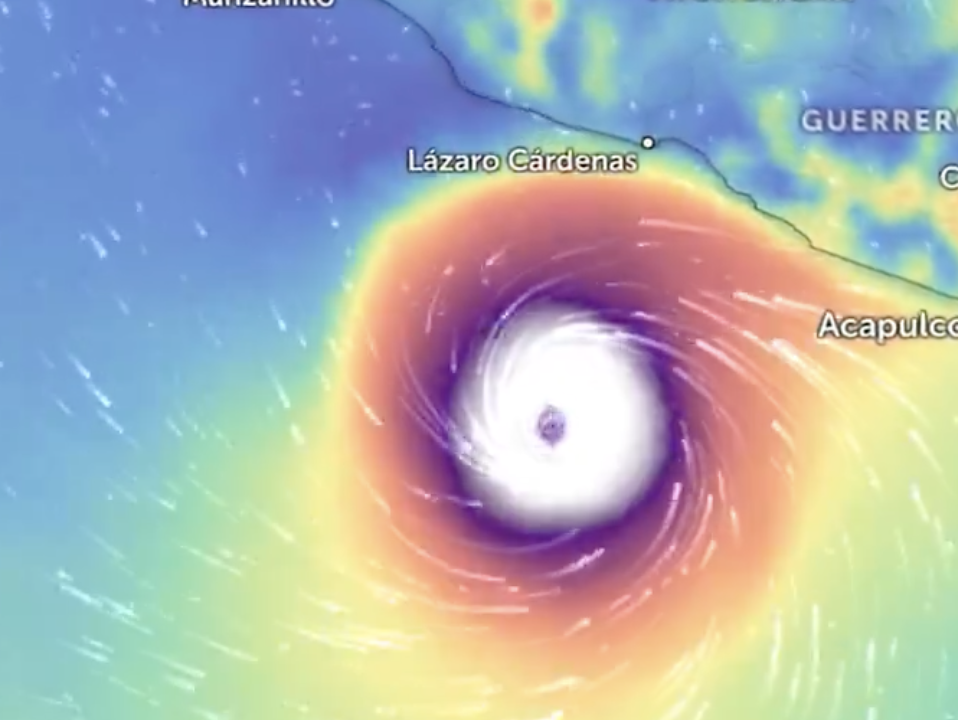
Hurricane Polo is tracking as one of the strongest Pacific tropical cyclones on record. As of September 22, the US National Hurricane Center in Miami reported sustained winds of 160 mph. The projected track keeps Polo offshore from the Baja California Peninsula and targets Mexico's Guerrero and Michoacan states for the heaviest rainfall, estimated at four to eight inches, with coastal flooding possible. Polo is not forecast to make direct landfall in California. The storm's northward moisture field and resulting atmospheric setup are expected to drive rip currents and heavy surface swells to Southern California beginning this weekend.
Southern California entered the current storm season already managing cumulative damage from prior events. Long Beach declared a local emergency September 22 following storm damage from Hurricane Marie, a Pacific tropical system that struck earlier in the season. Governor Newsom's September 22 statewide emergency declaration cites the National Oceanic and Atmospheric Administration's (NOAA) projection of a "Super El Nino" for the 2026-27 season. El Nino conditions warm the central and eastern Pacific, which amplifies both hurricane intensity and terrestrial flooding during storm events across the Western US.
The simultaneous activation of statewide and local emergency declarations creates coordination demands that can strain California's mutual aid infrastructure. Statewide gubernatorial declarations trigger the California Governor's Office of Emergency Services to activate its coordination center and resource mobilization pathways. Local declarations trigger separate resource request and reporting chains. When both levels are active concurrently in the same region, the interface between state operations centers and city emergency managers becomes a pressure point, particularly when local agency capacity has been drawn down by prior events.
Pacific hurricane threats to Southern California, while historically rare, are increasing in measured frequency as ocean surface temperatures rise. Direct tropical landfall in California has no modern analog beyond the 1858 San Diego hurricane. Indirect effects, including rainfall, coastal swells, and localized wind events, have caused measurable damage and casualties in Southern California during prior seasons. The northward extension of the Pacific tropical cyclone zone increases the likelihood that future storm systems will retain enough intensity to affect California waters before dissipating. Infrastructure at highest risk includes beach communities with inadequate drainage, hillside residential areas already on erosion watch from prior storms, and inland flood channels operating near capacity.
Public safety agencies in Southern California face concurrent operational demands this week. Coastal jurisdictions are deploying rip current warnings and pre-positioning lifeguard assets. Flood-prone communities need pre-staged response equipment. National Weather Service forecast offices in Los Angeles and San Diego are coordinating with local emergency managers to synchronize warning issuance. The Hawaii Island and Maui County were placed under separate flood watch as of September 22 due to a different central Pacific system, creating simultaneous Pacific-facing emergency management workloads across two distinct jurisdictions dependent on overlapping federal resources.
Federal Emergency Management Agency (FEMA) pre-positioned resources for the 2026 hurricane season are distributed primarily to Gulf Coast and Atlantic seaboard staging areas, reflecting the historical concentration of hurricane landfalls in those regions. Pacific-facing emergency management in California, Hawaii, and Oregon depends more heavily on state and local reserves than Gulf Coast jurisdictions, which have received sustained federal investment in pre-positioned assets. If Polo's indirect effects are more severe than current track forecasts project, California's ability to sustain simultaneous coastal flooding and emergency shelter operations without federal resource augmentation will be tested against a reserve baseline already drawn down from prior events this season.
SOURCES
