

Iran Negotiation Track Collapsing: US Strikes Iranian Territory, UAE Hit, Iran Has Not Returned Signature On MOU
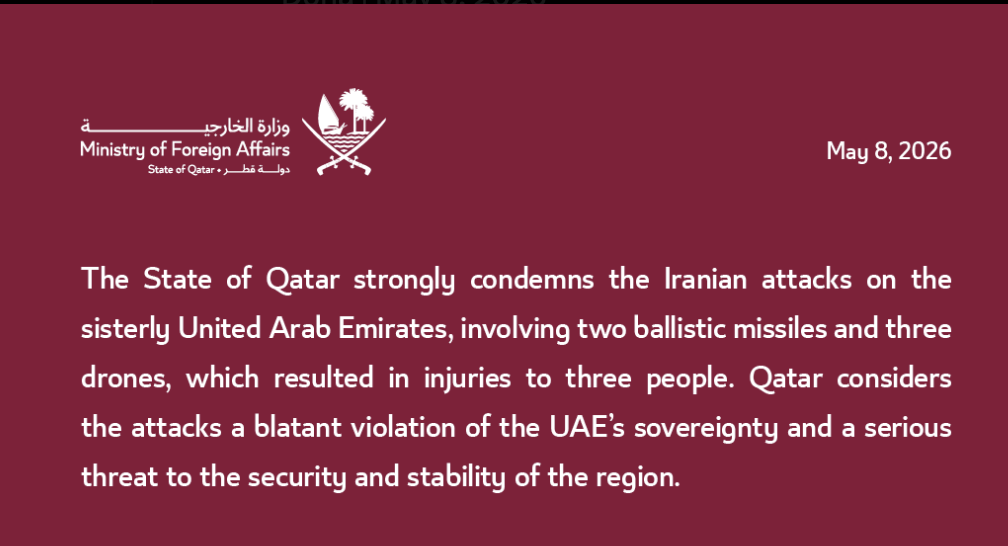
Source: X | MOFAQ
EXECUTIVE SUMMARY
The May 7 to May 8 escalation, US strikes on Iranian sovereign territory and Iranian strikes on the UAE, has structurally degraded the diplomatic track centered on the one page memorandum of understanding being negotiated by Steve Witkoff and Jared Kushner. Iran has not returned a signature on the framework as of late May 8 per ABC News reporting. President Trump has publicly threatened that bombing will resume at higher intensity if Iran does not sign, while CENTCOM has already executed the largest US strikes against Iranian sovereign infrastructure of the cycle.
ANALYSIS
The MOU framework, as reported by Axios and CNN earlier in the week, was a 14 point one page document declaring an end to the war and opening a 30 day window to detail the Hormuz reopening, an Iranian uranium enrichment moratorium of 12 to 15 years, sanctions relief, and the unfreezing of Iranian funds. The framework presumed both sides would continue tactical de escalation while text was finalized. Both sides have moved in the opposite direction in the last 48 hours.
The critical change is that US kinetic action has now crossed into Iranian sovereign territory at named locations: Qeshm Port, Bandar Abbas, Bandar Khamir, and Sirik. Iran's calculus on a moratorium agreement, which was already constrained by the loss of regional credibility from the Saudi Project Freedom snub, must now also factor in the political cost of signing a framework with the actor that struck the homeland at five points in a single 24 hour window.
Iran's response set has expanded in parallel. The UAE attack is the first kinetic strike against a Gulf state since the cycle began and signals that Iran is willing to pay the cost of widening the war beyond US naval and US flag targets. Iran will calculate that strikes against UAE infrastructure put pressure on the GCC's already wavering posture toward US operations and complicate any future US request to Saudi Arabia to reopen Prince Sultan Air Base or to Kuwait for airspace.
Inside Iran, the Iranian Army's public claim that one cruise missile and three drones struck the destroyer formation is a domestic credibility instrument, regardless of CENTCOM's denial. The hardline faction in Tehran has now held the moral and operational case for striking US warships and Gulf neighbors without the regime suffering existential damage. That makes a quick concession by the Supreme Leader on a US drafted MOU politically harder, not easier.
Iranian public messaging in pro Iran outlets on May 8 (Al Manar, Al Masirah) frames the US escalation as desperation, with headlines such as US Scrambling for European Backing as Allies Abandon Trump's Failing War on Iran. Iranian media also amplifies that Iran's trade routes and border security are intact despite the blockade. This messaging is consistent with a regime preparing the population for a longer fight rather than a fast settlement.
For US homeland posture, the next 7 to 14 days are the highest risk window for asymmetric Iranian retaliation. CISA advisory AA26-097A documented Iranian affiliated APT activity against US water, energy, and government services PLCs in the spring; that vector remains open. Iranian Quds Force aligned proxies in Latin America retain low signature options. Hezbollah linked surveillance networks against US Jewish community and Israeli affiliated infrastructure in CONUS have been a steady FBI investigative line for years. Any of those vectors becomes more probable each day the kinetic line continues to move and the MOU stays unsigned.
The most likely set of next 72 hour outcomes is one of three: Iran returns a marked up MOU with carve outs that buy time but reopen Hormuz; Iran continues regional kinetic action while keeping the homeland untouched, betting Trump will not authorize a strike on Tehran; or Iran's hardline faction forces a strike on a named US flag asset, which would push the conflict toward strikes on Iranian leadership infrastructure. The first option is the only one that preserves the negotiated 12 to 15 year nuclear moratorium that was the strategic prize of the framework.
SOURCES
