

Pakistan As Compromised Mediator: How The Nur Khan Disclosure Forces A Diplomatic Track Reset And Reshapes The Iran Endgame
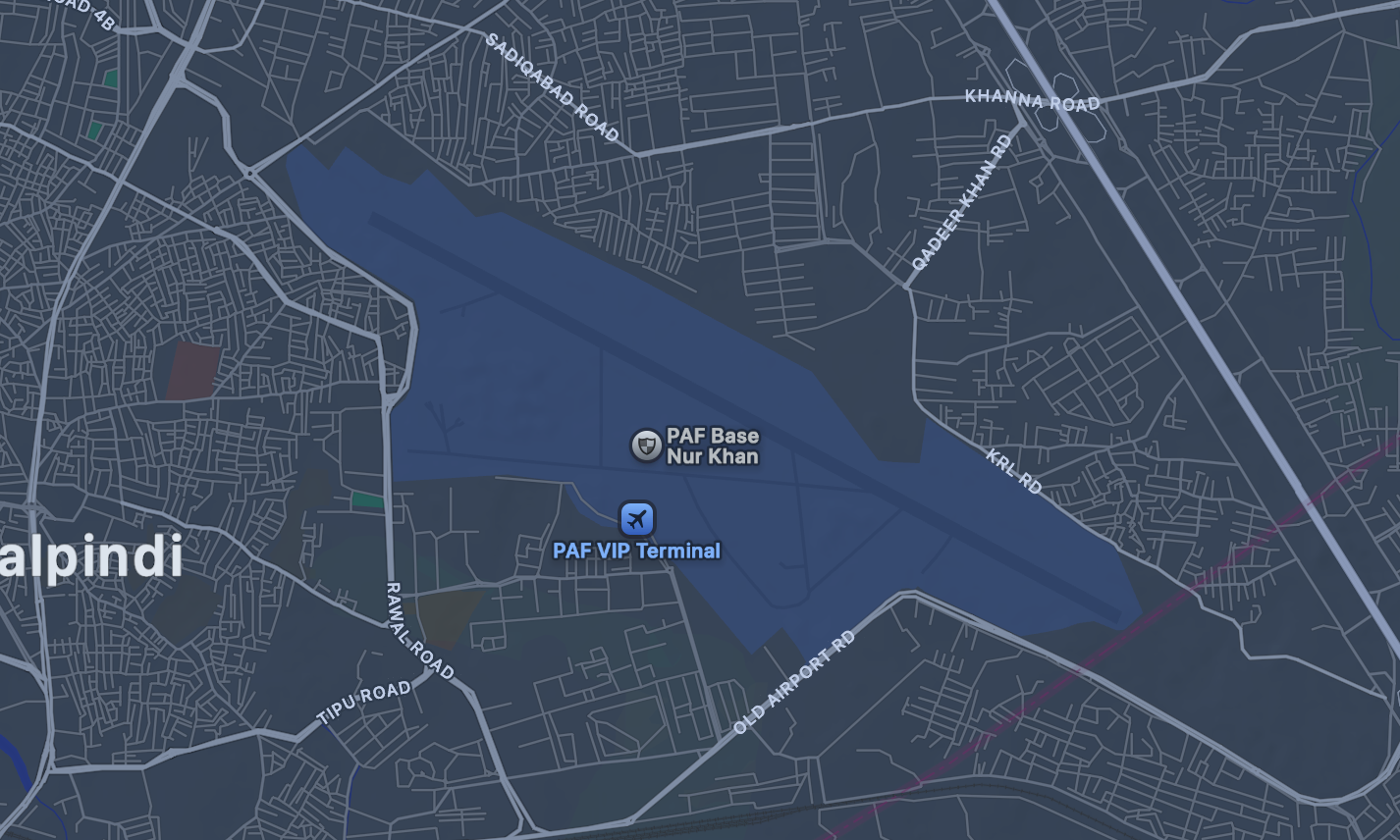
Source: Apple Maps
EXECUTIVE SUMMARY
CBS News's May 11 disclosure that Pakistan sheltered Iranian military aircraft at PAF Base Nur Khan during its declared role as US Iran mediator, and permitted sanctioned Iranian tanker transits through Pakistani waters, structurally compromises the diplomatic track that Witkoff and Kushner had built around Pakistani back channels. The disclosure forces a near term mediator change and reshapes the Iran endgame across three dimensions: legitimacy of mediated communications, integrity of CENTCOM blockade enforcement, and the political durability of any future framework signed under continued Pakistani sponsorship.
ANALYSIS
Pakistani back channels with Tehran have been operationally significant since the 1980s. Islamabad maintains religious, intelligence, and trade ties with Iranian counterparts that few other actors can replicate. The Witkoff and Kushner negotiating team chose Pakistan as primary intermediary because of those ties, with Omani back channel as secondary. The May 11 CBS disclosure does not eliminate the channel; it removes the political fiction that the channel was neutral.
The aircraft disclosure carries operational weight. The RC-130 ELINT platform is among the highest value Iranian air assets after the Boeing 707 fleet. Sheltering at Nur Khan during the active April to May strike window protected the platform from US strikes on Bandar Abbas and Qeshm Port and preserved Iranian electronic intelligence collection against US naval and air operations in the Gulf. Pakistan's denial, framed as physical implausibility because the base is in the heart of Rawalpindi, is a thin defense; aircraft parking is observable from commercial overflight and Sentinel imagery, and US officials would not have made the claim publicly without satellite verification.
The tanker disclosure is structurally more damaging. CENTCOM's Hormuz blockade has named over 50 vessels redirected, three Iranian flagged tankers disabled, and an unknown but larger volume aborted. If sanctioned Iranian oil is transiting through Pakistani territorial waters to onward markets, the economic impact of the blockade is partially neutralized. Saudi Aramco's May 10 disclosure of one billion barrels of cumulative supply removal becomes harder to attribute purely to Iranian production loss; some portion is being absorbed by alternate routing.
The political durability question is the hardest. A signed MOU that emerges from Pakistani mediation now carries an asterisk in US domestic politics. Sen. Lindsey Graham has publicly stated that the reporting, if accurate, requires complete reevaluation of Pakistan's role. Hardline Iran skeptics in Congress will use the disclosure to constrain the administration's policy space. The administration retains discretion to continue the track, but the political cost rises measurably.
Candidate replacement mediators carry different operational profiles. Oman is the most credible neutral with established back channels but has the least leverage on Tehran. Qatar hosts US Al Udeid Air Base, has been struck by Iranian drones on May 10, and cannot mediate without compromising operational equities for US strike planning. Saudi Arabia denied US basing on May 5 and has its own complicated history with Iran. Turkey is closer to Tehran than to Washington in current alignment. Switzerland, the traditional protecting power for US interests in Iran, has not been engaged on the current cycle.
Pakistan's domestic calculus is the wildcard. Islamabad's military leadership has structural reasons to maintain Iranian access: the Baluchistan border, the Iran Pakistan gas pipeline, and the Quetta Shura intelligence overlap. A public US confrontation with Pakistan during the Iran cycle could push Islamabad further into the Iranian and Chinese orbit. The administration's likely posture is to maintain the channel while quietly signaling that future US Pakistan engagement is contingent on transparent neutrality.
For the Iran endgame the practical effect is to compress the window in which a face saving MOU can close the cycle. If Pakistan is no longer trustworthy and no replacement mediator can carry the same weight with Tehran within days, the diplomatic track stalls. With the MOU already publicly rejected by both sides on May 10, the path of least resistance is military escalation, either a US strike package on Iranian nuclear infrastructure or the ground raid retrieval option that TWZ has elevated as a public policy possibility.
SOURCES
