

Russia Targets NATO Ukraine Supply Chain at Production and Logistics Nodes Simultaneously
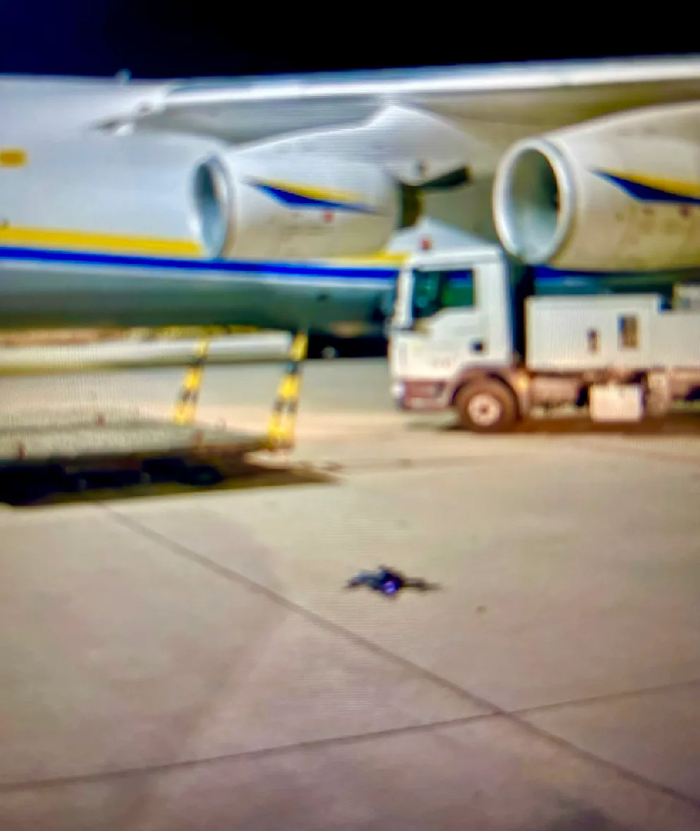
Reportedly an explosive-laden drone discovered at Germany's Leipzig/Halle Airport/Source: X | @sentdefender
EXECUTIVE SUMMARY
Within 72 hours, Russian sabotage operations struck a Polish drone factory and a German North Atlantic Treaty Organization (NATO) military air cargo hub, hitting the Ukraine supply chain at both a production node and a distribution node in the same operational window. Germany formally attributed the Leipzig/Halle Airport drone attack to Russian state entities on September 1, 2026. Polish Prime Minister Donald Tusk confirmed deliberate arson at WB Electronics in Skarzysko-Kamienna on September 2. The pairing of these two targets is not coincidental.
ANALYSIS
On August 4, 2026, a drone carrying an explosive device was found near a Ukrainian Antonov An-124 cargo aircraft parked at Leipzig/Halle Airport in Germany. A police bomb disposal robot defused the device before it detonated. Germany formally attributed the incident to Russia on September 1. Interior Minister Alexander Dobrindt stated that the drone configuration, components, explosives, and detonator are 'known to us from other Russian hybrid operations,' and that while the attack demonstrated 'a high degree of technical expertise,' execution was left to 'low-level agents.' Hours after Berlin's statement, Polish Prime Minister Tusk told reporters that Poland had experienced new acts of sabotage 'within the past dozens of hours,' confirming the WB Electronics arson as deliberate and the work of a foreign intelligence service. Polish prosecutors opened parallel terrorism and foreign intelligence investigations.
The two targets answer a specific intelligence question: what does Russia gain by hitting both at once? WB Electronics is Poland's largest privately owned defense company and the manufacturer of the FlyEye reconnaissance drone and Warmate loitering munition used by Ukrainian forces and Polish military units. Leipzig/Halle is one of Europe's largest air freight hubs and home to NATO's Strategic Airlift International Solution (SALIS), which operates almost daily delivering equipment to NATO battlegroups from Finland to Romania. One target is a production node; the other is a distribution node. Damaging both in the same window compresses the supply chain at two points simultaneously.
Neither attack is isolated. An incendiary device ignited at a Leipzig/Halle logistics center in 2024, setting fire to a freight container before it could be loaded onto a cargo plane; that incident was also attributed to Russian-linked activity. The Associated Press has tracked approximately 200 incidents of sabotage and malign activity across Europe blamed on Russia since the invasion of Ukraine, including arson at warehouses, drone attacks, theft of defense technology, and cyberattacks against critical infrastructure. The tactical execution pattern across incidents is consistent: proxy or low-level actors, incendiary or explosive devices, single-point attacks on logistics and production infrastructure, and no direct involvement of Russian intelligence officers who could generate attribution evidence.
The operational theory is cumulative degradation. No individual attack needs to destroy a factory or shut down an airport. A warehouse fire that destroys drone components delays deliveries. A drone attack that forces aircraft ground inspections or schedule changes at a NATO logistics hub introduces friction and cost. Multiple small disruptions across the supply chain, sustained over months, degrade the pace at which Ukraine receives materiel without triggering the kind of single spectacular incident that would demand a proportional military response. Interior Minister Dobrindt described the model directly: centrally planned by Russian state entities and 'carried out by people acting on behalf of Russian state entities,' but insulated by the use of local proxy executors.
Germany's diplomatic response reflects the seriousness of the attribution. Foreign Minister Johann Wadephul announced the closure of the Russian consulate in Bonn effective September 18, and the Russian House cultural center in Berlin. Germany will propose additional Russian nationals for European Union sanctions in connection with hybrid attacks, step up entry controls for Russian nationals, and increase pressure on Russia's shadow fleet tanker network. NATO Secretary-General Mark Rutte stated: 'NATO stands in full solidarity with Germany after the Russian hybrid attack in Leipzig.' Germany's Cabinet approved plans in mid-August to expand intelligence service authority to disable sabotage and hacking attempts; those plans still require parliamentary approval.
SOURCES
