

Jihadist Violence Escalates in Benin–Niger–Nigeria Border Triangle as JNIM and ISSP Entrench
Source:
Executive Summary
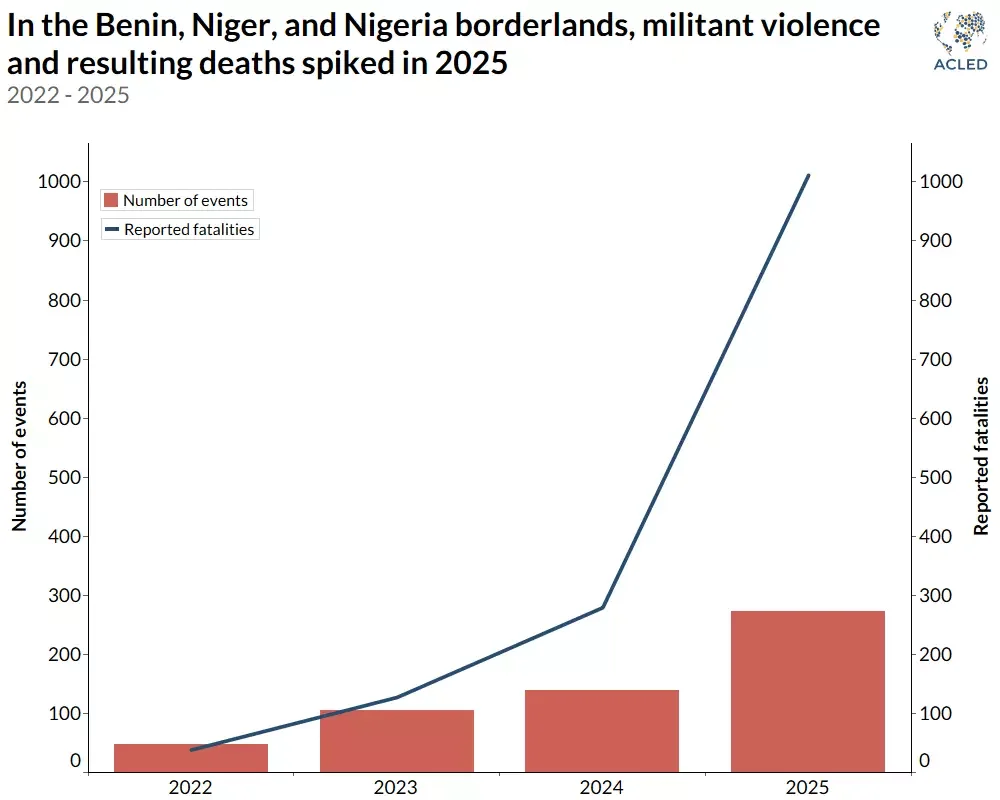
The Armed Conflict Location & Event Data (ACLED) project assesses that jihadist violence in the Benin–Niger–Nigeria borderlands has entered a new phase defined by entrenchment, higher lethality, and more overt signaling by Jama’at Nusrat al-Islam wal-Muslimin (JNIM) and Islamic State Sahel Province (ISSP). ACLED reports violent events increased 86% from 2024 to 2025 in the affected border regions, while fatalities rose 262%.
Analysis
ACLED describes the borderlands as a connected conflict zone where militants are no longer just expanding outward from the Sahel, but consolidating and professionalizing their footprint.
Scale and lethality: ACLED’s headline trend is more incidents and far more deaths, reflecting faster operational tempo and greater civilian exposure across Benin’s Alibori and Borgou, Niger’s Dosso, and Nigeria’s Sokoto, Kebbi, Niger, and Kwara areas referenced in the piece.
Country-specific dynamics: In Benin, ACLED points to sporadic but highly lethal cross-border raids against the military. In Niger, it describes parallel JNIM and ISSP campaigns that indicate consolidation and expansion, including operations near Niamey. In Nigeria, ACLED highlights overlapping activity in the northwest and north-central corridor involving ISSP and multiple Nigerian actors, increasing complexity on the ground.
Claims and attribution: ACLED notes JNIM has increasingly claimed attacks publicly along the Benin–Nigeria border, while ISSP has also begun official claims in the Niger–Nigeria borderlands. The report argues “Lakurawa” is often a catch-all label that can obscure ISSP-linked activity, complicating attribution and response planning.
Why it’s sticking: ACLED ties durability to weak state presence, degraded cross-border coordination, and terrain advantages—forest belts, protected reserves, and remote wooded hills that function as transit routes and staging areas rather than temporary hide sites.
Embedding and resourcing: The report highlights recruitment across multiple communities (not a single ethnic pipeline), co-option of bandits, and reliance on illicit trade routes—especially fuel smuggling corridors and riverine transport networks—linking local livelihoods to militant taxation/protection arrangements.
External pressure and messaging risk: ACLED connects December U.S. strikes in Sokoto to containment of ISSP expansion, while flagging that political framing of those strikes may not align with the group targeted, which can distort threat understanding.
