

Trump Issues 'Tuesday Strike Warning' Against Iranian Power Plants and Bridges; April 6 Deadline Becomes Hardened Threshold
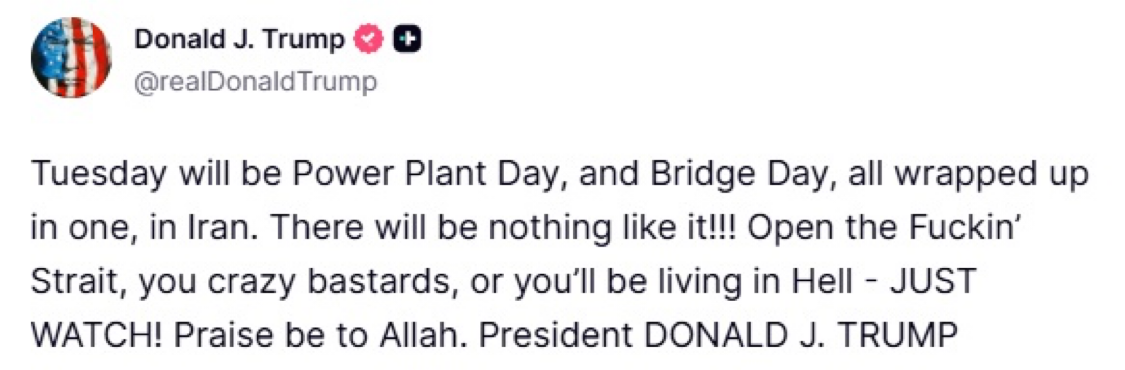
Source: Truth Social
EXECUTIVE SUMMARY
President Trump issued an escalatory Easter Sunday threat on April 5 via Truth Social, warning Iran that Tuesday, April 7, would be 'Power Plant Day, and Bridge Day' if the Strait of Hormuz remained closed. Trump's language was explicit: 'Open the Fuckin' Strait, you crazy bastards, or you'll be living in Hell.' Tehran rejected the ultimatum, with Iranian state media characterizing Trump's messaging as 'helpless' and 'nervous.' A major press conference with military leadership is scheduled for Monday, April 6 at 1:00 PM Eastern. US Special Envoy Steve Witkoff separately said he believed diplomatic meetings with Iran would occur 'this week,' creating deliberate ambiguity between the military threat and a diplomatic off-ramp.
ANALYSIS
Trump's explicit naming of power plants and bridges as April 7 targets represents the most direct public presidential threat to civilian infrastructure since the conflict began on February 28. Legal analysts immediately flagged that strikes on objects indispensable to civilian survival would constitute potential war crimes under international humanitarian law. The White House has not qualified the threat with lawful targeting caveats, and Pentagon officials have not publicly confirmed or denied operational planning for Tuesday strikes against infrastructure. The prior three energy infrastructure strike moratoriums that Trump imposed and then extended suggest the Tuesday threat may again be used as coercive leverage rather than an operational order.
Iran's response framing Trump as 'helpless' and 'nervous' is consistent with a deterrence posture designed to project confidence domestically while leaving diplomatic space open. Iranian FM Araghchi has systematically denied each US characterization of Iranian concessions throughout the conflict, a pattern that provides Iranian leadership plausible deniability while indirect talks continue through Pakistan, Egypt, and Turkey. Witkoff's statement that 'there may be people within the Iranian system today who just don't have the ability to admit the negotiations' suggests US diplomats believe the Iranian negotiating position is constrained by internal factional pressures rather than strategic intransigence.
Monday's Oval Office press conference with military leadership is the highest-profile military-political event of the conflict to date. The format, which mirrors past Trump announcements of major military decisions, will be closely watched for signals of whether Tuesday represents genuine escalation or another extension of the coercive pressure campaign. For domestic audiences, the Easter Sunday messaging paired with the successful airman rescue creates a narrative of military strength and divine favor that the White House appears to be deliberately constructing ahead of a consequential 48-hour window. Oil markets, which have responded to each strike pause extension, will be acutely sensitive to Monday's statements.
