

The Light of Jihad: ISIS Central Media Elevates African Theaters and Urges Future Strikes on Europe
Executive Summary
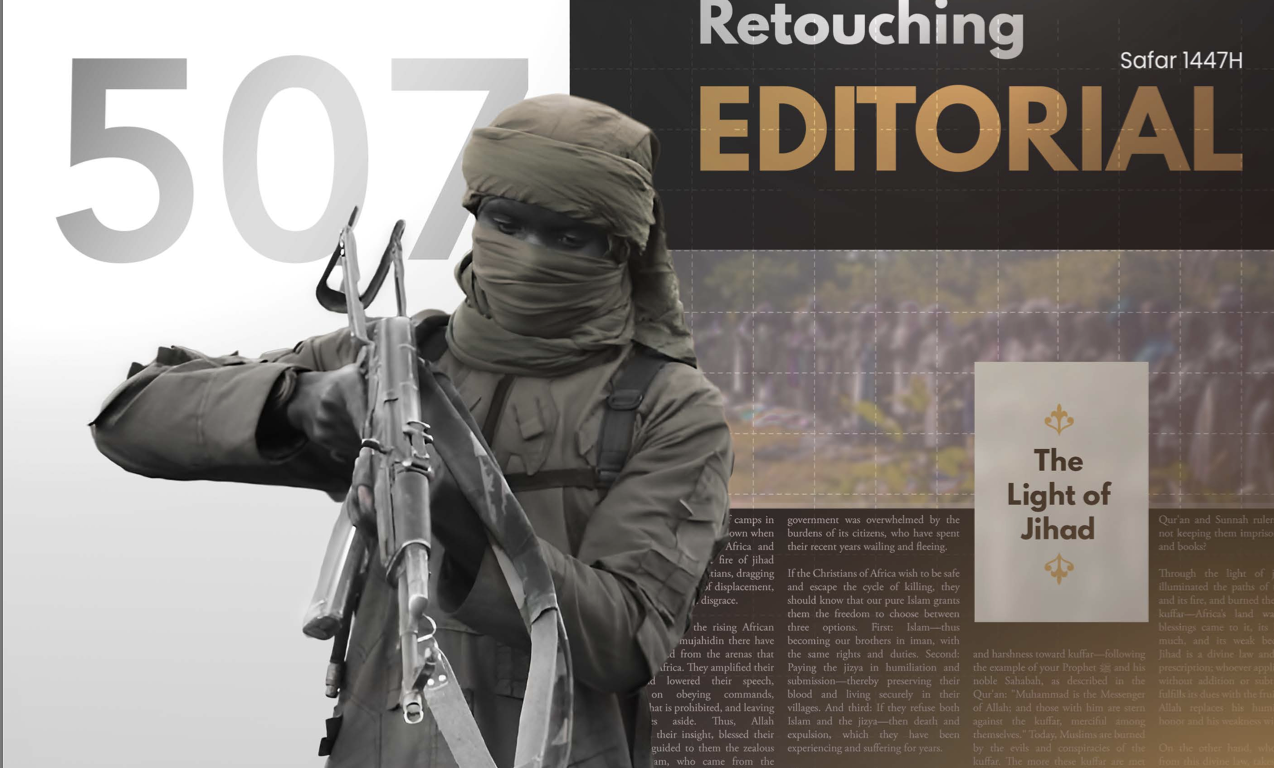
An editorial in issue 507 of ISIS’s An-Naba newsletter, titled “The Light of Jihad,” frames recent attacks in the Democratic Republic of Congo and Mozambique as proof that “African jihad” is now a vanguard front for the organization. The piece praises massacres of Christians, outlines a three-option “convert, pay jizya (non-Muslim tax), or die/expulsion” framework for African Christians, and explicitly urges ISIS fighters in Africa to deepen operations and eventually “carry” jihad into Europe. The editorial reinforces earlier communiqués from ISIS Central Africa and West Africa affiliates claiming attacks in Ituri (DRC) and Borno State (Nigeria), and seeks to capitalize on Western focus on Christian casualties and Gaza to justify further sectarian violence.
Analysis
ISIS’s An-Naba editorial positions Central and Southern Africa as a rising priority front, celebrating recent mass-casualty operations and using them to justify more systematic targeting of Christians while calling for eventual expansion into Europe. The messaging aims to harden sectarian lines, legitimize attacks on civilians as religious obligation, and rally global supporters around the African theaters at a time when ISIS core remains under pressure in Iraq and Syria.
The editorial lauds recent operations in eastern DRC (Ituri/Irumu area, including Kamanda) and northern Mozambique (Chiure, Muidumbe, Ancuabe), describing church attacks, village burnings, beheadings, and mass displacement of “cross-worshippers” as proof that the “flames” of jihad in Central and Southern Africa are again rising after a lull.
It presents a rigid three-tier ultimatum for African Christians—conversion to Islam, payment of jizya “in humiliation and submission,” or “death and expulsion”—and boasts that in some areas Christians have already been forced into paying or converting while “most” still face the “third option,” explicitly normalizing continued massacres and ethnic-religious cleansing.
The piece denounces “Crusader” governments and “beastly human rights institutions” for condemning attacks on Christians in Africa while allegedly ignoring Gaza and other Muslim causes, framing global human rights discourse as hypocritical and urging fighters to treat “humanity” as an enemy to be “slaughtered with the knife of loyalty and disavowal.”
It exhorts African cells to show “mercy to Muslims” and “severity and harshness toward the kuffar,” citing Qur’anic verses to justify indiscriminate violence, and characterizes armed jihad—not politics or democracy—as the sole path to “ending oppression and seizing authority,” juxtaposing “the light of jihad” against the “darkness of jahiliyyah.”
The editorial explicitly calls on “knights of Islam in Africa” to strengthen faith and capabilities so they can eventually “carry its trust and deliver it to the shore of Europe—to invade it, shatter its security, and turn its streets and capitals into another Ituri and Cabo Delgado,” keeping the idea of attacks inside Europe alive as a long-term strategic goal.
This editorial fits into a broader ISIS propaganda line that has recently highlighted Africa as a locus of momentum, complementing prior claims from Islamic State Central Africa Province (ISCAP) and Islamic State West Africa Province (ISWAP) about attacks on Christians and state forces in Ituri (DRC) and Borno (Nigeria). It appears designed to:
– reassure supporters that ISIS remains potent despite losses elsewhere;
– reframe local conflicts in DRC, Mozambique, and Nigeria as part of a global, sectarian religious war; and
– incite both local fighters and potential foreign volunteers by promising religious legitimacy, spoils, and the prospect of eventually striking Europe.
From a security perspective, the editorial underscores three risks: sustained or escalated sectarian targeting of Christians and other civilians in African theaters; further attempts to extract jizya, impose de facto parallel rule, and engineer mass displacement in contested areas; and longer-term efforts by African-based ISIS cells or inspired individuals to plot external operations, including against European interests. The text is explicitly propagandistic, unverified as to specific casualty claims, and intended to incite; it should be treated as a window into intent and strategic framing, not as reliable reporting of events on the ground.
Sources
An-Naba No. 507 editorial “The Light of Jihad”
