

FPV Drones Destroy US Black Hawk Helicopter and Sentinel Radar at Victory Base Complex, Baghdad
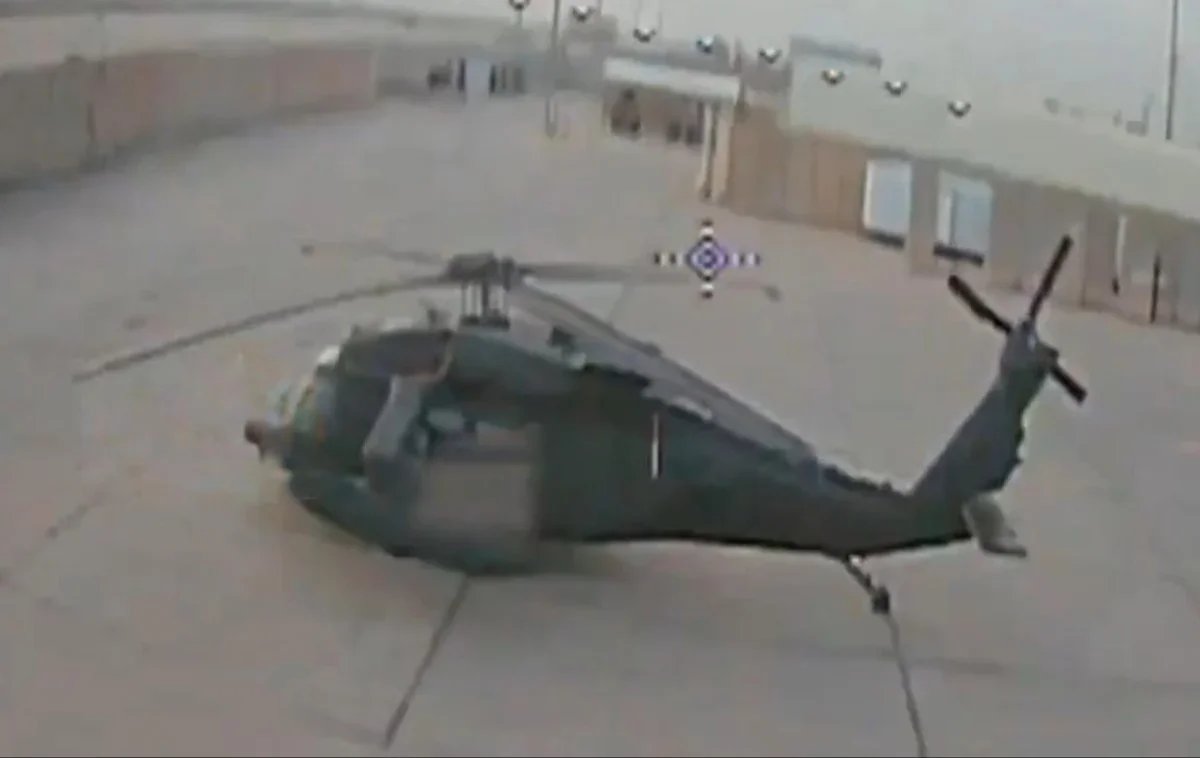
Source: Defence Blog
EXECUTIVE SUMMARY
Iran-backed Iraqi militias executed a coordinated fiber-optic-guided first-person view drone attack on Victory Base Complex near Baghdad International Airport on 25 March 2026, destroying a US Army UH-60M Black Hawk helicopter and an AN/MPQ-64 Sentinel short-range air defense radar. The Islamic Resistance in Iraq, with Kataib Hezbollah assessed as the primary actor, released video confirming the strike. The attack marks the first confirmed destruction of a US military rotary-wing aircraft by enemy drone action in the current conflict and demonstrates a decisive tactical leap: fiber-optic guidance renders electronic jamming ineffective against these platforms.
ANALYSIS
The attack struck the former Camp Victory diplomatic support center, where US forces maintain a logistics and advisory presence. Video footage circulating on pro-militia channels shows a drone striking the UH-60M Black Hawk while the aircraft sat on a landing pad, with the drone appearing to connect with the rotor assembly. A second drone hit the AN/MPQ-64 Sentinel radar, setting it ablaze. Both systems were assessed as destroyed or severely damaged based on the visual evidence reviewed.
The tactical significance of fiber-optic guidance cannot be overstated. Standard US jamming suites are designed to disrupt radio-frequency control links. Fiber-optic tethered drones transmit control signals through a physical cable that is entirely immune to RF jamming, HERF systems, and directional spoofing. Each platform costs a few hundred dollars, compared to the approximately 6 million dollar replacement value of the HH-60M variant and the multi-million dollar Sentinel radar system. The cost-exchange ratio strongly favors the attacker.
The choice of targets is operationally deliberate. The Black Hawk represents US power projection and medical evacuation capability in theater; its destruction signals that even support-function aircraft at ostensibly secure bases are now at risk. The Sentinel radar is a linchpin of the base's own air defense architecture, meaning its destruction reduces the complex's ability to detect follow-on drone and missile attacks. US forces are currently engaged in ceasefire negotiations with Iraqi militia factions, but this attack suggests hardline factions within the Islamic Resistance are not bound by or are actively undercutting those discussions.
The deployment of fiber-optic FPV technology by Iraqi militias follows the widespread adoption of this technique by Russian forces in Ukraine. The technology transfer pathway almost certainly runs through Iranian IRGC channels, which have been supplying both doctrinal knowledge and hardware to proxy forces across the region. US installations across Iraq and Syria should be assessed as facing an elevated and ongoing threat from fiber-optic-guided systems for which current electronic countermeasures provide no protection.
