

Yemen’s Power Balance Shifts as Southern Forces Seize Eastern Provinces
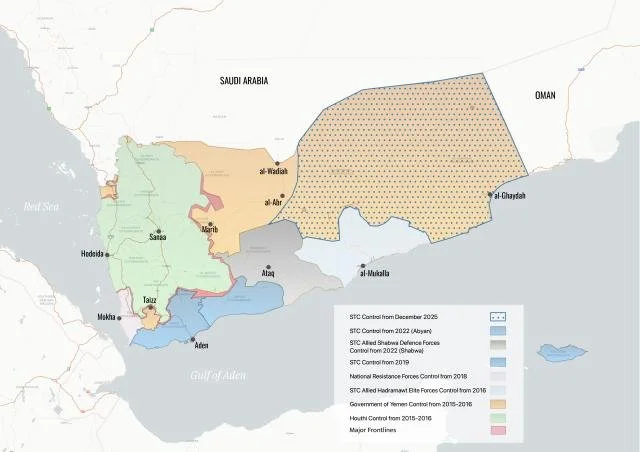
Source: Washington Institute
Executive Summary
Yemen’s internal balance of power has shifted sharply after the Southern Transitional Council (STC), backed by the United Arab Emirates, seized control of Hadramawt and al-Mahra in December 2025. The move has brought Saudi Arabia and the UAE into open tension, weakened Yemen’s internationally recognized government, and increased the risk of renewed conflict that could benefit the Iran-backed Houthis. While framed by the STC as a security operation, the takeover has deep regional implications for Red Sea stability, Gulf relations, and prospects for ending Yemen’s long war.
Intelligence Analysis
The rapid advance by the Southern Transitional Council in early December marked one of the most consequential shifts in Yemen’s conflict in years. In a matter of days, STC-aligned forces overran military bases, government buildings, and oil infrastructure across Hadramawt before pushing east into al-Mahra. Together, these two governorates make up nearly half of Yemen’s landmass and include most of its remaining oil resources. Their loss has severely undercut the authority of the internationally recognized government and pushed long-simmering rivalries among its foreign backers into the open.
At a tactical level, the takeover was striking for how little resistance it encountered. Saudi-aligned military units in the Hadramawt interior largely withdrew or handed over positions without sustained fighting. The National Shield Forces, trained and supported by Riyadh, melted away from key sites. Even Yemen’s Presidential Leadership Council remained largely silent as events unfolded, reinforcing widespread perceptions that the government lacks both unity and the ability to enforce its writ. Only after the STC had consolidated control did President Rashad al-Alimi publicly condemn the operation as a unilateral act that undermined the state.
The speed of the advance initially fueled speculation that Saudi Arabia and the UAE had quietly agreed to redraw the map of eastern Yemen. That impression quickly faded. Riyadh demanded a full withdrawal of STC forces from Hadramawt and al-Mahra, while Abu Dhabi privately acknowledged the need for de-escalation but did not compel its local allies to reverse course. A joint Saudi-Emirati delegation traveled to Aden in an attempt to contain the crisis, yet developments on the ground continued to point toward escalation rather than compromise.
For Saudi Arabia, the loss of influence in Hadramawt is not a marginal issue. The governorate shares a long border with the kingdom and has deep historical, tribal, and economic ties to Saudi society. Riyadh views the area as a buffer zone critical to its national security and to sustaining supply lines to Marib, the last major government stronghold against the Houthis in the north. In response to the STC’s advance, Saudi Arabia reinforced positions along the frontier, secured the al-Wadiah crossing and the al-Abr junction, and reportedly warned that it could use air power if its red lines were crossed. It also evacuated remaining Saudi forces from Aden, signaling a deliberate effort to politically and militarily isolate the STC.
Oman faces a parallel dilemma in al-Mahra. The sparsely populated eastern governorate has long maintained closer social and economic links to Oman than to Yemen’s political centers. Muscat has historically opposed the militarization of the region and is wary of any force that could disrupt cross-border ties or facilitate smuggling routes. The STC’s decision to raise its flag near the Omani border immediately triggered warnings from Muscat and added another layer of regional sensitivity to the crisis.
The STC, for its part, has framed its offensive as a necessary step to restore security and combat extremist threats. Its leadership has argued that Saudi-backed units in Hadramawt were corrupt, ineffective, and infiltrated by hostile elements, including Islamist factions and smugglers allegedly linked to the Houthis. By adopting this narrative, the council seeks to present itself as a stabilizing force rather than a separatist actor accelerating Yemen’s fragmentation. At the same time, the seizure of oil-producing areas advances the STC’s long-standing goal of building the economic foundations for an independent southern state.
Timing also matters. The offensive unfolded amid expectations that Saudi Arabia and the Houthis might eventually resume talks aimed at a broader settlement. By moving first, the STC appears to have sought leverage over any future negotiations, particularly given the Houthis’ interest in Yemen’s oil revenues. Control of Hadramawt strengthens the STC’s hand in any discussion about resource sharing, autonomy, or postwar governance.
The takeover has already produced second-order effects. STC forces redeployed from other fronts to support the advance, leaving installations such as Al-Anad Air Base more exposed. Houthi fighters have probed southern lines in Lahj and other areas, testing whether internal divisions among anti-Houthi forces have created openings. While southern forces have so far repelled these attempts, the risk is clear: renewed infighting among government-aligned factions historically benefits the Houthis, allowing them to consolidate gains elsewhere with minimal resistance.
From a regional perspective, instability in eastern Yemen carries implications far beyond its borders. Hadramawt’s oil fields and al-Mahra’s coastline sit astride routes that matter for energy markets, maritime security, and Red Sea shipping. Any prolonged conflict could disrupt supply lines, create new smuggling corridors, and offer extremist groups space to regroup. Al-Qaeda in the Arabian Peninsula, though weakened, has historically exploited precisely such governance vacuums.
Looking ahead, several scenarios are plausible. A negotiated compromise could see STC forces partially withdraw from the Hadramawt interior in favor of locally rooted units acceptable to Saudi Arabia, allowing all sides to claim a measure of success. Alternatively, failure to reach accommodation could trigger fighting between Yemeni factions, draw in regional actors more directly, and hand strategic opportunities to the Houthis. The most destabilizing outcome would be a premature declaration of southern independence, which would likely provoke international isolation and encourage northern forces to realign against the STC.
Analyst Note
The STC’s advance has exposed how thin Yemen’s current political framework has become. Power now rests less with formal institutions than with armed actors backed by competing regional sponsors. Without sustained external pressure to align Saudi and Emirati objectives, local dynamics are likely to continue driving Yemen toward deeper fragmentation rather than reconciliation.
Sources
The Washington Institute – Yemen’s seismic shift has consequences beyond its borders
Associated Press – Yemen’s sides agree to release detainees in largest exchange
Semper Incolumem – STC advance signals a new phase in Yemen’s fragmentation
The Telegraph – The carnage in Yemen deserves the world’s attention
Jacobin – Yemen’s civil war takes a dangerous new turn
UN News – UN urges restraint as tensions rise in eastern Yemen
Anadolu Agency – Yemen’s separatists defy calls for withdrawal
Anadolu Agency – Presidential council warns takeover threatens regional security
