

Attack on Soft Targets and Crowded Places: ISIS-Inspired Violence and the Growing Need for Vigilance

Executive Summary
A series of disrupted plots, mass-casualty attacks, propaganda releases, and battlefield incidents over recent months highlight a persistent and evolving threat from ISIS-inspired actors targeting soft targets and crowded civilian spaces. From thwarted Christmas market attacks in Germany and Poland, to a deadly mass shooting at a religious event in Australia, to the killing of U.S. service members in Syria, these incidents demonstrate how ISIS and its ideological ecosystem continue to prioritize symbolic, high-visibility targets that maximize fear, media attention, and societal disruption. While ISIS no longer controls a territorial “caliphate,” its operational model—combining propaganda, lone-actor inspiration, and decentralized violence—remains highly effective, particularly against public gatherings with limited security.
Intelligence Analysis
The defining characteristic of recent ISIS-inspired activity is not territorial conquest or complex coordinated operations, but the persistent focus on soft targets: places where civilians gather for cultural, religious, or celebratory purposes. Christmas markets, religious events, holiday celebrations, beaches, and public ceremonies remain attractive targets because they combine symbolic value, high foot traffic, and predictable routines. This pattern reflects continuity with ISIS’s long-standing doctrine, rather than a tactical shift.
Recent arrests in Germany underscore this threat. Authorities detained five men suspected of planning a vehicle-ramming attack against a Christmas market in Bavaria. According to prosecutors, the alleged instigator explicitly called for an attack designed to kill or injure as many people as possible, echoing ISIS’s repeated encouragement of low-tech, high-impact violence. The plot follows a well-established trajectory: ideological motivation, simple means, and selection of a target associated with Western culture, Christianity, and seasonal symbolism. German officials credited intelligence cooperation for preventing the attack, but the case illustrates how little logistical sophistication is required to generate a credible mass-casualty threat.
A similar pattern emerged in Poland, where security services arrested a university student accused of planning an explosives attack on a Christmas market while seeking direct contact with ISIS. Unlike many lone-actor cases, this suspect reportedly attempted to establish organizational support, suggesting that ISIS’s appeal still extends beyond passive inspiration to active affiliation-seeking. Even though authorities disrupted the plot early, the case reinforces that Christmas markets remain a preferred target across Europe due to their accessibility and symbolic resonance.
These European cases cannot be viewed in isolation. They align with a broader environment of heightened alert and risk mitigation across the continent. France’s decision to cancel its traditional New Year’s Eve concert on the Champs-Élysées—a public event that had drawn crowds of up to a million people—reflects growing concern that large, open-air celebrations present unacceptable security risks. French authorities explicitly cited terrorism, including threats from ISIS and al-Qaeda, alongside volatile crowd dynamics and prior unrest. While controversial, the move signals an acknowledgment that preventive security measures increasingly involve altering or canceling public life rather than relying solely on policing.
The threat is not confined to Europe. In Australia, the mass shooting at a Hanukkah event at Bondi Beach represents one of the deadliest ISIS-inspired attacks in a Western country in recent years. Fifteen people were killed and dozens wounded when a father and son opened fire on a religious gathering. Investigators found ISIS flags and improvised explosive devices, and officials publicly stated that the attackers were inspired by ISIS ideology. The suspects reportedly shouted religious slogans during the attack, reinforcing its ideological dimension.
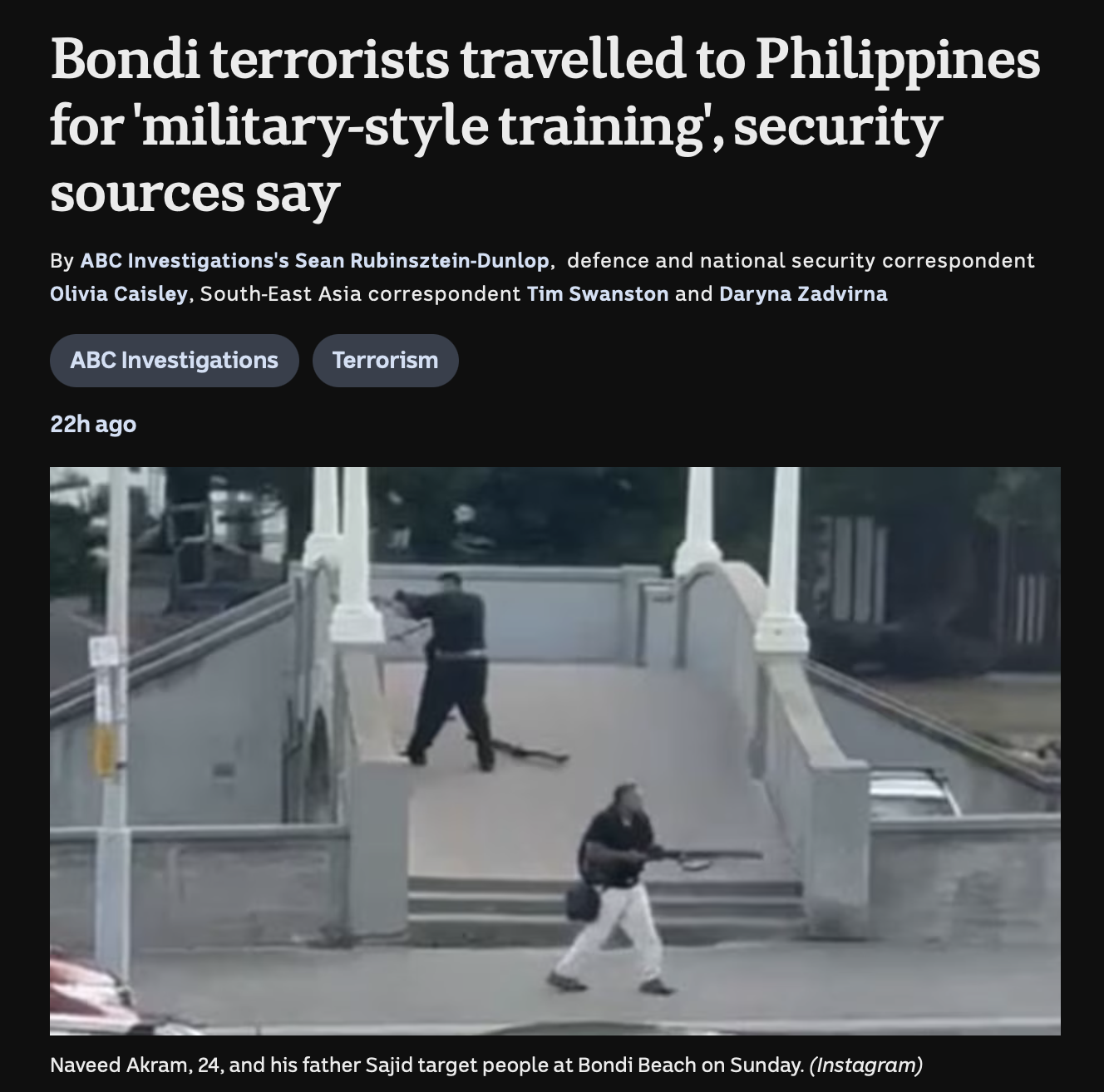
Source: ABC News
The Bondi Beach attack illustrates several critical trends. First, it demonstrates how ISIS’s propaganda continues to motivate individuals far removed from active conflict zones. Second, it shows how religious and communal events—particularly Jewish gatherings—remain high-priority targets in extremist narratives. Third, it highlights the blurred line between lone-actor terrorism and small-cell violence: while the attackers were family members, their actions were not directed by ISIS operatives but clearly aligned with its messaging.
At the same time, ISIS continues to demonstrate its capacity for direct violence in active theaters of conflict. The deadly ambush in Syria that killed two Iowa Army National Guard soldiers and a civilian interpreter underscores that ISIS remains operationally lethal against hardened military targets, not just civilians. The attack near Palmyra involved a lone gunman but resulted in multiple fatalities and injuries, reminding policymakers that ISIS retains the ability to exploit gaps in force protection even after years of sustained counterterrorism pressure.
Parallel to physical attacks, ISIS’s media ecosystem continues to play a central role in sustaining momentum. Recent issues of Al-Naba emphasize African operations while attacking rival Islamist factions in Syria, portraying ISIS as both a fighting force and a governing authority. The focus on Africa—Nigeria, the Democratic Republic of Congo, Mozambique, and Somalia—reinforces the group’s narrative that it is expanding geographically despite losses elsewhere. These publications serve multiple purposes: they reassure supporters, intimidate adversaries, and provide ideological justification for continued violence.
Supporter media channels have amplified this effect. English-language propaganda posters circulated by ISIS-aligned outlets glorify martyrdom, threaten Western governments, and encourage recruitment. Although unofficial, these materials closely mirror ISIS’s core branding and rhetoric, demonstrating how decentralized networks keep the ideology alive even without centralized direction.
Equally concerning is the circulation of operational paranoia narratives within pro-ISIS online spaces. A recent post in a TechHaven channel warned supporters that phones can be used to track and target individuals, exaggerating surveillance capabilities to foster fear and isolation. While some technical claims are loosely grounded in reality, the overall messaging aims to create a siege mentality, discouraging normal civic engagement and reinforcing extremist identity.
Taken together, these developments reveal a coherent strategic pattern. ISIS and its supporters are not attempting to recreate the territorial caliphate of 2014. Instead, they are exploiting psychological impact as their primary weapon. Soft targets and crowded places offer disproportionate returns: they are easy to access, difficult to fully secure, and capable of generating fear that far exceeds the operational cost of the attack.
This approach also places liberal societies in a strategic dilemma. Protecting every market, festival, or public gathering indefinitely is neither practical nor desirable. Yet repeated attacks and disrupted plots create pressure to curtail public life, alter traditions, and accept a permanent state of heightened alert. In this sense, ISIS’s strategy succeeds even when attacks are thwarted, because the disruption itself becomes the outcome.
Outlook
The near-term threat environment suggests continued risk to public gatherings, religious events, and seasonal celebrations in Western countries. ISIS-inspired actors are likely to persist with low-tech attack planning, while propaganda ecosystems continue to encourage vigilance avoidance, paranoia, and ideological commitment. Absent a major shift in governance, online moderation, and community resilience, soft targets will remain the most attractive avenue for extremist violence.
Analyst Note
The consistent focus on soft targets reflects ISIS’s understanding that terrorism is fundamentally psychological. Even failed plots and canceled events advance the group’s objectives by reshaping public behavior. Counterterrorism strategies that focus solely on arrests and battlefield victories risk overlooking this broader impact. Long-term mitigation will require not only intelligence and policing, but sustained efforts to protect public life without surrendering it.
Sources
BBC News – Five arrested over plot to attack German Christmas market
ABC News – Bondi Beach mass shooting suspects traveled to Philippines weeks before attack
Times of Israel – Poland nabs student suspected of planning Christmas market attack in support of ISIS
New York Post – Paris cancels New Year’s Eve concert on Champs-Élysées over security fears
Fox News – Iowa police chief’s son among National Guard members killed in Syria ISIS attack
Semper Incolumem – Pro-ISIS TechHaven post promotes surveillance fear narrative
Semper Incolumem – ISIS uses Al-Naba Issue 525 to showcase African operations
Semper Incolumem – Africa’s widening crisis: rising conflict and extremist violence
Semper Incolumem – ISIS supporter media channels circulate new propaganda posters
Semper Incolumem – ISIS resurgence highlighted by raids, court cases, and territorial losses
